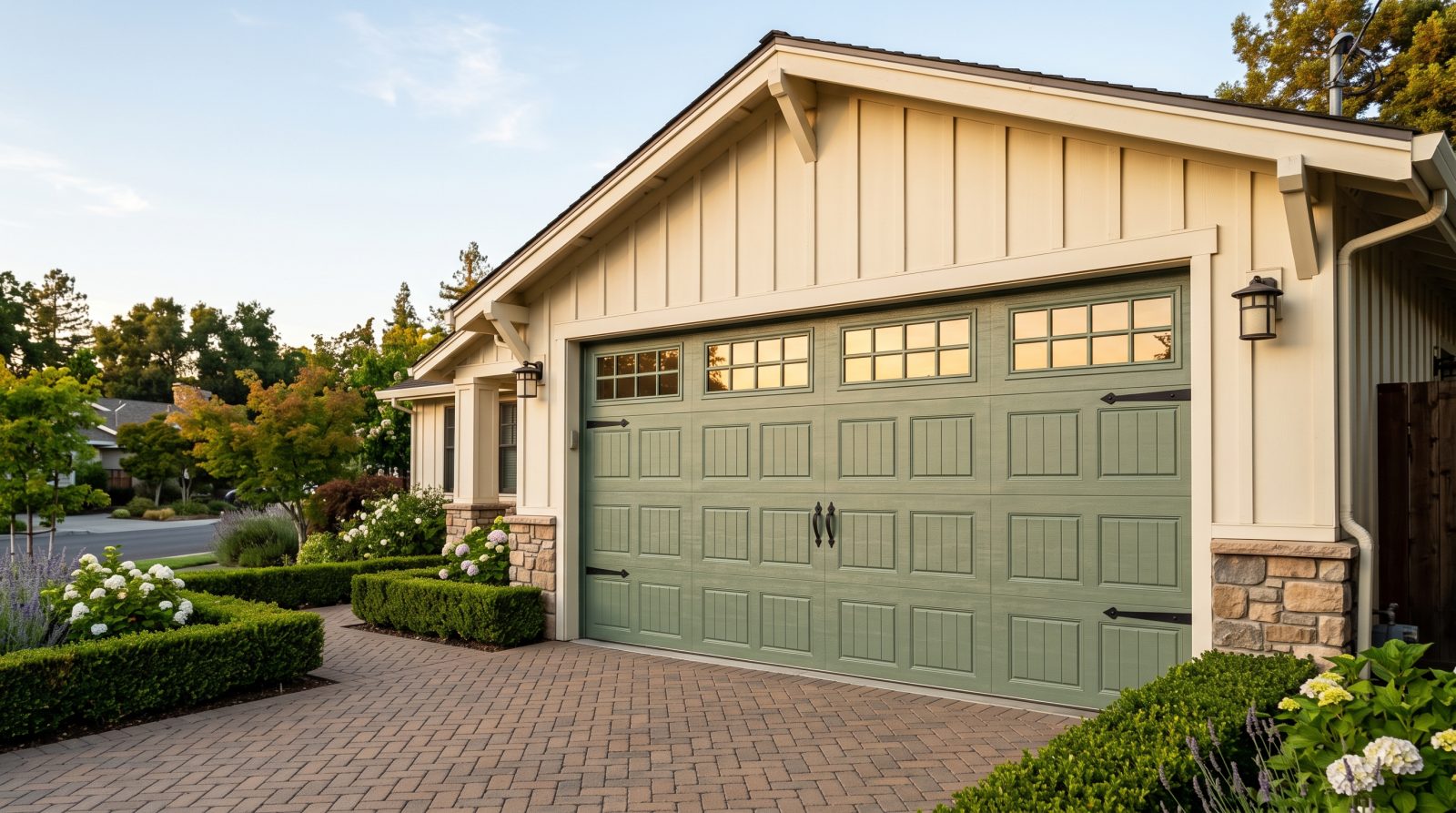
What a Carriage House Garage Door Actually Is
A carriage house garage door is styled to look like the side-hinged, swing-out doors of a historic carriage barn, but in almost every modern installation it is not actually a swing door. It is a standard sectional overhead door, the kind that rolls up on tracks, dressed with details that recreate the carriage look: faux strap hinges, decorative handles, vertical plank lines, and often a row of windows across the top section. You get the character of the old style with the convenience, safety, and weather sealing of a contemporary opener system.
This distinction matters in Sacramento because of how we live with our garages. True swing-out doors need clear space in front to open and do not pair with an automatic opener easily. The overhead carriage door tucks up under the ceiling, keeps your driveway usable, and works with the same remotes, keypads, and smartphone openers as a plain door. A small number of homeowners do want genuine swing or sliding carriage doors for a detached structure or a specific architectural look, and that is a real option worth discussing on site, but the overhead carriage-style door is what fits the majority of attached Sacramento garages.
Because the difference is invisible from the street, you capture the full curb-appeal payoff either way. The goal of the style is the impression it makes from the sidewalk, the driveway, and the front-facing photos that matter when you eventually sell.
- Overhead sectional door with carriage styling: the most common and most practical choice
- Faux strap hinges and handles that mimic real swing hardware without the maintenance
- Optional true swing-out or sliding doors for detached garages or period homes
- Full compatibility with modern openers, keypads, and smart-home controls
Why Carriage Style Boosts Curb Appeal on Sacramento Homes
Sacramento neighborhoods run a wide range of architecture, and carriage house doors flatter more of them than almost any other style. In established areas like Land Park, East Sacramento, and the Fabulous Forties, the warmth of a carriage door sits naturally against Tudor, craftsman, and traditional facades. In newer subdivisions around Natomas, Elk Grove, Roseville, and Folsom, a carriage door adds the custom, built-to-order feeling that a flat panel door simply cannot, breaking up large stucco-and-tract elevations with texture and shadow lines.
The reason it works is proportion. On a typical two-car or three-car Sacramento home, the garage door can occupy a third or more of the front elevation. A plain door reads as a blank slab; a carriage door reads as a designed feature, with the eye drawn to the hinges, the window line, and the way the planks catch our long Central Valley afternoon light. That play of light and shadow is especially flattering during golden hour, when low summer sun rakes across the door face.
Curb appeal is not only about how you feel pulling in at night. For homeowners thinking about resale, the front-facing photo is the first thing buyers see online, and the garage is usually in that frame. A carriage door upgrade is one of the more visible, photograph-friendly improvements you can make to the exterior, and it is finished in a single visit rather than the weeks a larger remodel demands.
- Complements craftsman, Tudor, and traditional homes in older Sacramento neighborhoods
- Adds custom character to stucco tract homes in Natomas, Elk Grove, and Roseville
- Breaks up large blank elevations with hinge detail, window lines, and shadow
- Strong impact in front-facing listing photos when it comes time to sell
Materials and Finishes That Hold Up in the Central Valley
Material choice is where a carriage door either ages gracefully or becomes a chore, and the Sacramento climate is a real factor. Our summers deliver weeks of triple-digit heat and intense UV, while winters bring damp, foggy stretches. A door that looks great in a brochure needs to handle thermal expansion, fading, and moisture without warping or peeling.
Steel carriage doors, often with a composite-overlay or embossed wood-grain face, are the practical workhorse for most Valley homes. They resist warping, take a baked-on or factory finish that stands up to UV better than site-applied paint, and can be ordered insulated, which genuinely matters for attached garages baking in summer heat or for any garage used as a gym, shop, or hangout. Insulation also helps quiet the door and adds rigidity. Faux-wood steel and composite overlays now mimic real grain convincingly enough that most people cannot tell from the curb.
Real wood carriage doors deliver unmatched authenticity and are the right call for certain high-end or historic homes, but they ask for more in return: periodic refinishing and a watchful eye on sun and moisture exposure. If you love genuine wood, plan for that maintenance honestly rather than being surprised by it. For finishes, popular Sacramento choices include warm natural wood tones, deep stains, classic white or almond, and increasingly dark bronze and charcoal for a modern-farmhouse look. Window options range from clear to frosted to decorative inserts, and we will hold samples against your trim, stucco, and roof color before anything is ordered.
- Insulated steel and composite: best all-around durability and value for Valley heat
- Faux-wood overlays that read as real grain from the curb with far less upkeep
- Genuine wood for authenticity, with honest expectations about refinishing
- Finish and window choices matched on site to your trim, stucco, and roofline
How Our Mobile Carriage Door Service Works
We are a mobile garage door company, which means the entire process happens at your home, not at a storefront. We come to you to take exact measurements of the rough opening, headroom, and side room, because a carriage door has to be specified to your actual structure rather than a generic size. We look at how your existing tracks, springs, and opener are set up and whether they will carry the new door or need to be addressed as part of the project.
Next we help you design the door against your real house. Photos in a catalog never capture how a finish looks next to your stucco at 4 p.m. in June, so we bring options to compare on the spot: panel layouts, hinge and handle styles, window placement, and color. Because carriage doors are typically made to order, getting these choices right before the order goes in is what separates a door you love from one that is merely fine. Once the door is built and arrives, we handle the full installation: removing the old door, setting the new sections and tracks, balancing the springs, and tuning the opener and safety sensors so everything runs smoothly and safely.
Throughout, you get clear, itemized pricing before any work begins, and you can request a free quote first with no obligation. We serve homeowners across the Sacramento area and surrounding communities, and same-day visits are often available for measurements and quotes so your project can get moving quickly.
- On-site measuring of opening, headroom, and side room for a made-to-order fit
- Design consultation with finishes and hardware compared against your home
- Full installation: old door removal, new door, spring balancing, opener tuning
- Clear pricing up front and same-day measure-and-quote visits when available
Carriage Door Costs and What Drives the Range
Because carriage doors are usually custom-built, pricing varies more than it does for a basic panel door, so it helps to understand the levers rather than fixate on a single number. As a general industry guide, insulated steel carriage-style doors typically fall in a mid-to-upper price range compared with plain steel doors, while genuine wood and fully custom builds sit at the top end. These are industry ranges, not a quote for your home; the only accurate figure is the one we give after measuring your opening.
Several factors move the price. Size is the biggest: a wide three-car door uses more material and heavier hardware than a single. Material and construction matter next, with insulated and composite doors costing more than single-layer steel, and real wood more than both. Window inserts, decorative hardware, premium finishes, and any custom panel layout each add to the total. Finally, the condition of your existing system plays a role: if springs, tracks, or the opener need to be replaced to safely carry the new door, that is part of the project scope and we will spell it out clearly.
The right way to think about it is value over the life of the door. A well-built, properly insulated carriage door is a long-lived exterior feature that improves how your home looks and feels every day and shows well at resale. We will give you an honest, itemized estimate so you can weigh options like insulation, material, and window choices against your budget before you decide.
- Door width and number of car bays: the single largest cost driver
- Material and construction: single-layer steel vs insulated, composite, or real wood
- Windows, decorative hardware, premium finishes, and custom panel layouts
- Condition of existing springs, tracks, and opener, scoped clearly in your estimate