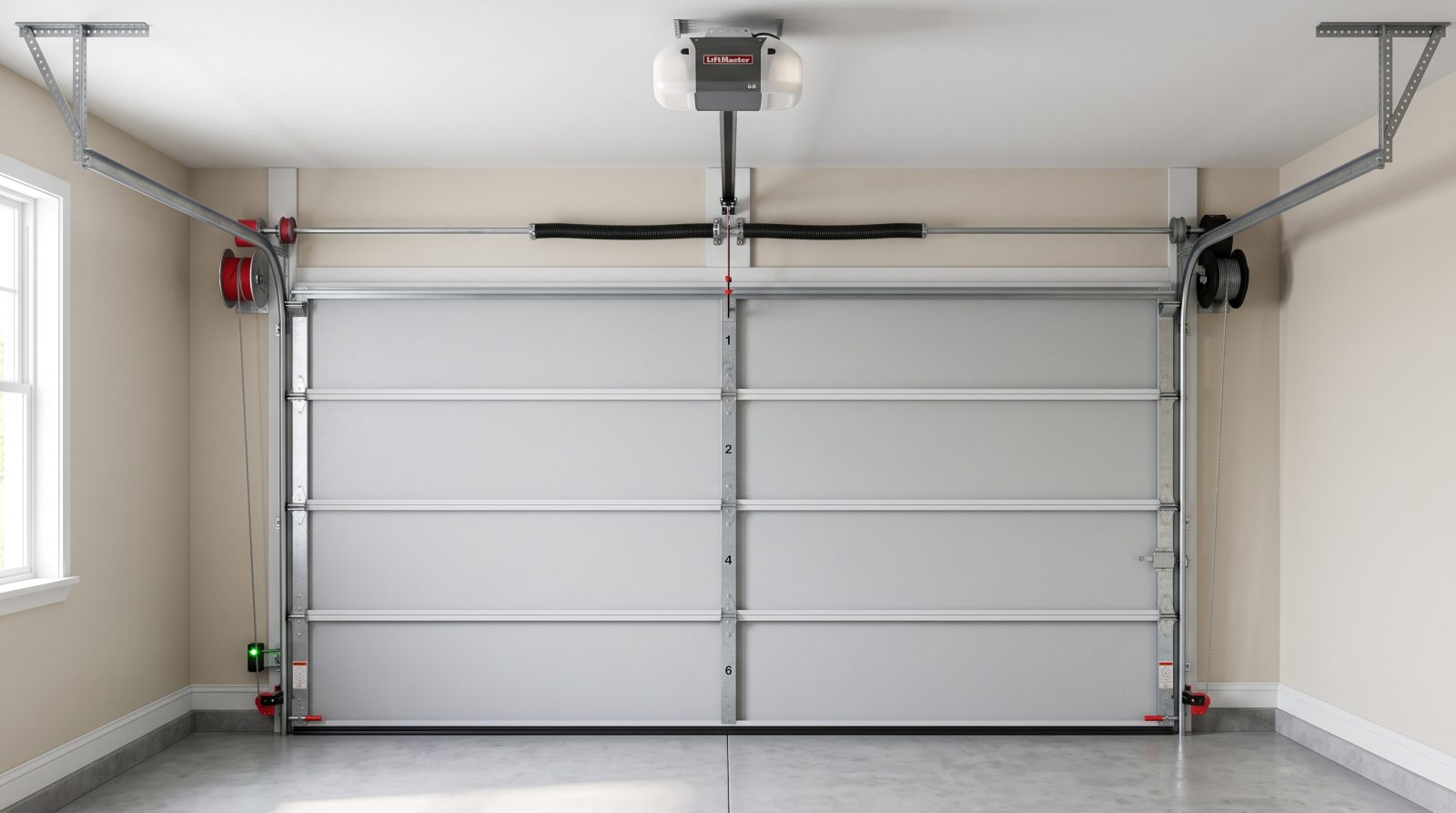
The Big Idea: A Garage Door Is a Counterbalance Machine
The most important thing to understand about a garage door is that the motor does not do the heavy lifting. People assume the opener on the ceiling is what hauls a 200-pound door up and down, but that small unit only produces around half a horsepower. It could never lift that weight on its own, and it is not designed to. The real lifting is done by a spring system that stores and releases energy, and the opener simply nudges an already-balanced door in the right direction.
This is why a properly tuned door feels almost weightless when you disconnect the opener and lift it by hand. The springs are wound to exactly counterbalance the weight of the panels, so the door 'floats' at any height you leave it. When you hear someone say their door 'got really heavy' or 'slammed down,' what they are describing is a counterbalance failure, almost always a spring that has lost tension or broken. The motor is now being asked to lift weight it was never built to handle, which is how a relatively minor spring repair turns into a burned-out opener if it is ignored.
Everything else in the system, the cables, drums, tracks, and rollers, exists to guide that counterbalanced weight smoothly and safely along a fixed path. Once you see the door as a balance machine rather than a motor-driven lift, every other part starts to make sense.
Springs and Cables: Where the Real Lifting Happens
There are two spring systems you will find on Sacramento homes, and knowing which you have helps you understand your door. Torsion springs mount on a metal shaft above the door opening and store energy by twisting; they are the heavier-duty, longer-lasting, and safer option found on most modern doors. Extension springs run along the horizontal tracks on each side and stretch like a long coil; they are common on older homes and lighter single-car doors. Both do the same job, counterbalancing the door, but they fail in different ways.
Springs are wear items with a finite lifespan, typically rated in 'cycles,' where one cycle is a single up-and-down operation. A standard spring is often rated for roughly 10,000 cycles. A two-car household opening the door four to six times a day can reach that number in about seven to ten years, sometimes sooner. Sacramento's wide temperature swing matters here: steel contracts in cold and expands in heat, and that cold snap during a Delta-breeze winter morning is the single most common moment for an already-fatigued spring to snap. That loud bang homeowners describe, like a gunshot in the garage, is almost always a torsion spring letting go.
Working alongside the springs are the lift cables, steel cords that connect the bottom of the door to grooved drums on the torsion shaft. As the springs unwind, the cables wrap onto the drums and pull the door up evenly on both sides. If you ever see one side of the door tilt, hang crooked, or a frayed cable dangling, stop using the door immediately. A door under spring tension with a failed cable can move violently. Spring and cable work is the one area of garage door repair we strongly recommend leaving to a technician, because the stored energy in a wound torsion spring is genuinely dangerous to release without the correct winding bars and training.
- Torsion springs sit above the door on a shaft; extension springs run along the side tracks
- Most springs are rated around 10,000 cycles, roughly 7 to 10 years of normal household use
- Cold Sacramento winter mornings are the most common time for a fatigued spring to break
- A loud bang from the garage almost always means a snapped torsion spring
- Frayed cables or a crooked, tilting door are signals to stop using it and call for help
Tracks, Rollers, and Hinges: The Guidance System
Once the springs handle the weight, the tracks, rollers, and hinges control where the door goes. The vertical and horizontal steel tracks form a curved path that lets a flat door rise straight up and then turn to lie flat under the ceiling. Inside those tracks, rollers, small wheels on stems, let each panel glide rather than scrape. Hinges connect the panels and flex at exactly the right point as the door bends around the curve in the track.
Rollers are a quietly important part. Cheap builder-grade plastic rollers wear out and get noisy; nylon rollers with sealed bearings run far quieter and last much longer. When a door suddenly becomes loud, grinding, rattling, or squealing, worn rollers and dry hinges are the usual suspects long before anything serious is wrong. In our dry Sacramento Valley climate, dust and fine grit from the Central Valley settle into roller bearings and tracks, which is why doors here often get loud from contamination rather than rust. A simple cleaning and proper lubrication frequently quiets a door that owners assumed needed major repair.
Track alignment is the other thing to watch. A car bumper tap, a settling foundation, or loose lag bolts can knock a track slightly out of position. The early warning is a door that binds, hesitates, or makes a clunk at the same spot every time. Bent tracks should never be hammered back by hand, because forcing a door along a misaligned track stresses the rollers, hinges, and opener all at once. Catching a track issue early usually means a small adjustment instead of replacing damaged panels later.
- Tracks form the curved path; rollers let panels glide; hinges flex the door around the bend
- Nylon rollers with sealed bearings run far quieter and outlast plastic builder-grade rollers
- Central Valley dust and grit in the bearings is a common cause of a suddenly noisy door
- A clunk or hesitation at the same spot every cycle often points to a track alignment issue
- Never force or hammer a bent track; misalignment stresses the entire system at once
The Opener and Its Safety Features
The opener is the automation layer on top of the mechanical door. It includes a motor unit on the ceiling, a drive system, a chain, belt, or screw, that moves a trolley along a rail, and the trolley pulls or pushes the door via an arm. Chain drives are durable and economical but louder, which matters if you have a bedroom over the garage. Belt drives are noticeably quieter and popular in newer Sacramento homes. The opener also houses the logic board, the radio receiver for your remotes, and increasingly Wi-Fi for phone control.
Two safety systems are federally required on residential openers and are worth understanding because they cause many 'my door won't close' calls. The first is the pair of photo-eye sensors mounted about six inches off the ground on each side of the door. They project an invisible beam across the opening, and if anything breaks that beam, a pet, a trash can, a child, the door reverses. The second is auto-reverse force sensing: if the door contacts an object on the way down, it is designed to stop and go back up. These features exist because a closing door has enough force to injure a child, and they are not optional.
Here is the practical part for homeowners. When a door closes a few inches then goes back up, or the opener lights blink and it refuses to close, the cause is very often a misaligned or dirty photo eye, not a broken opener. A bumped sensor, a spider web across the lens, or sun glare can all break the beam. Realigning the eyes until both indicator lights glow steady solves a large share of these calls. Understanding this one feature saves Sacramento homeowners a lot of unnecessary worry, and it is also why you should never disable the sensors to force a door shut.
- Chain drives are durable but loud; belt drives are quieter for homes with rooms over the garage
- Photo-eye sensors sit about six inches up on each side and reverse the door if the beam breaks
- Auto-reverse force sensing stops and reverses the door if it hits an object on the way down
- A door that closes partway then reverses is usually a dirty or misaligned sensor, not a dead motor
- Never disable safety sensors to force a stuck door closed; they exist to prevent injuries
How It All Works Together in One Cycle
Putting the pieces together, here is what happens in the two or three seconds it takes your door to open. You press the remote, the opener's receiver recognizes the signal, and the logic board tells the motor to engage. The trolley begins moving along the rail and pulls the door's arm upward. At the same moment, the wound springs release their stored energy, doing the actual lifting, while the cables wrap onto the drums and raise both sides evenly.
As the door rises, the rollers track the steel guides and the hinges flex each panel around the curve so the door transitions from vertical to horizontal and parks flat overhead. The whole motion is smooth because the spring tension is balanced against the door's weight; the opener is just steering and adding a small assist. On the way down, the process reverses, and the photo eyes stand guard the entire time, ready to reverse the door if anything crosses the opening.
When every component is healthy, this happens quietly and reliably thousands of times a year. Problems show up as small deviations from that smooth cycle: a new noise, a hesitation, a sag on one side, a door that feels heavier by hand. Those are the moments to pay attention. Because we are a mobile service that comes to your driveway anywhere in the Sacramento area, the best time to have a door looked at is when you first notice one of those changes, not after a spring breaks and traps your car inside the garage.
- A single cycle blends spring energy release, cable lift, roller guidance, and opener steering
- The springs lift the weight; the opener mainly steers and adds a small assist
- Photo eyes monitor the opening throughout every close, ready to reverse instantly
- New noises, hesitation, one-sided sag, or a heavier feel are your earliest warning signs
- Catching a change early usually means a minor adjustment instead of an emergency repair