What "off track" really means
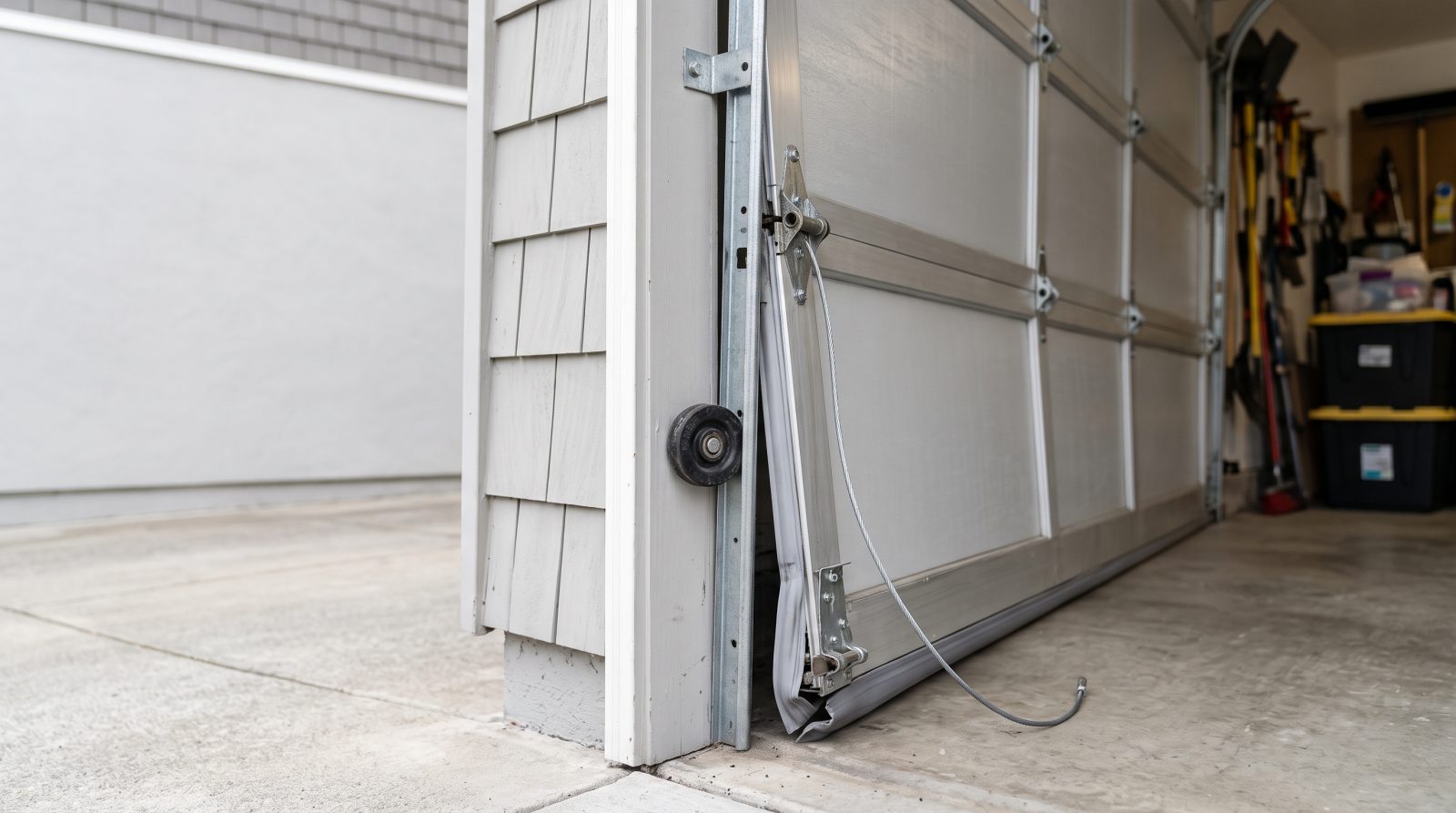
A residential garage door is not one solid slab. It is a series of hinged horizontal panels fitted with small wheels, called rollers, that ride inside a pair of steel tracks running up each side of the opening and curving back along the ceiling. When the door is balanced and the system is healthy, those rollers glide smoothly inside the tracks and the spring system carries almost all of the door's weight. "Off track" simply means one or more of those rollers has come out of the channel it is supposed to ride in. Once even a couple of rollers escape, the panel they belong to loses its guide, twists out of plane, and drags the panels above and below it out of alignment too.
The reason this looks so dramatic is that the door is heavy and the geometry is unforgiving. A typical double door weighs well over a hundred pounds, and when one side jumps the track the weight redistributes unevenly. You will often see the door wedged at an angle, one bottom corner jammed against the floor or the door frame, with a roller dangling free or a cable hanging slack off its drum. It may be stuck halfway, refusing to go up or down, or it may have come down hard and pinched. None of this means the door is destroyed. In most cases the panels are fine and the fix is mechanical, but only if the door is handled correctly from this point forward.
- Rollers are the small wheels that ride inside the vertical and horizontal tracks
- "Off track" = one or more rollers has left the track channel
- A double door can weigh well over 100 lbs, so off-track weight shifts unevenly
- Panels usually survive; cables, rollers, and track sections are the common casualties
- A door stuck at an angle is under uneven load and should not be operated
Why garage doors come off track in the Sacramento area
Doors do not jump their tracks at random. There is almost always an underlying cause, and identifying it matters because simply popping the rollers back in without fixing the root issue means the door will derail again. The single most common trigger we find is impact: a car bumper tapping the door while it is partway up, a basketball or bike knocking a lower panel, or a door being closed onto an object left in the opening, like a trash bin, a ladder, or a garden hose reel. Even a light strike at the wrong spot can knock a roller out and bend the track lip just enough to let the rest follow.
Wear and neglect are the slower causes. Sacramento summers are long and hot, and the dry Central Valley heat bakes the old factory grease off rollers and hinges. Then the wet, cold stretches of winter and the fine grit that blows in from nearby fields and construction work the rest of the way in. Dry, gritty rollers wear flat, seize up, and hop the track. Loose lag bolts, which we see constantly on doors that have run for years without a tune-up, let the track itself drift out of position until the rollers no longer have a clean path to follow. A broken or stretched lift cable can also yank one side of the door out of square in an instant. Finally, a worn or broken spring throws the whole door out of balance, forcing the opener and the tracks to fight a load they were never meant to carry, which accelerates a derailment.
Older homes throughout midtown, Land Park, Oak Park, and the established neighborhoods of Carmichael and Fair Oaks frequently have original or first-generation steel tracks that have softened and bowed over decades. Newer tract developments in Natomas, Elk Grove, and Roseville tend to have builder-grade rollers that simply wear out on schedule. We see both ends of that spectrum, and the diagnosis is what tells us whether you need a roller set, a track section, a cable, or a spring service alongside getting the door back on its rails.
- Vehicle or object impact while the door is partway open is the number-one cause
- Sacramento heat dries out factory lubricant; valley grit then chews up rollers
- Loose lag bolts let tracks drift out of alignment over years of use
- A snapped or stretched lift cable can pull one side off track instantly
- A broken or unbalanced spring overloads the tracks and accelerates derailment
- Older central-Sacramento homes often have softened, bowed original tracks
Why you should never force an off-track door back into place
This is the most important section on the page, because the damage we repair is frequently not the original derailment but what happened when someone tried to fix it themselves. When a door is off track, the load is no longer balanced, and the parts that are still connected are under strange, often extreme tension. The lift cables in particular can be wound tight on their drums or hanging loose with stored energy waiting to release. Reaching into the track to lever a roller back, or pushing the door up to "reseat" it, puts your fingers and hands directly in the path of pinch points that can amputate or crush. People get badly hurt doing exactly this, and a heavy panel that lets go can drop fast.
The second hazard is the spring. The torsion or extension spring system stores an enormous amount of energy to counterbalance the door's weight. If the door came off track because a spring failed, or if the off-track condition has shifted load onto a spring, any attempt to muscle the door can cause that spring or its hardware to release violently. We never advise homeowners to touch springs, drums, or cables, and we treat them as the most dangerous components on the door.
Beyond the safety risk, forcing it almost always costs you money. Levering a roller back into a slightly bent track gouges the track further. Pushing on a misaligned panel bends the panel and tweaks the hinges. Cranking the door against a jammed corner can snap a cable or strip the bottom fixture. What might have been a roller-and-realignment visit becomes a panel replacement and a cable job. The right move the moment you see a door off its tracks is simple: stop, do not operate the opener, do not pull on the door, keep kids and cars clear, and request a free quote. Leaving it alone costs nothing and protects both you and the cheaper repair.
- Off-track doors are under uneven, unpredictable tension
- Cables and springs store enough energy to injure hands and crush fingers
- Pressing the opener button can jam the door harder or snap a cable
- Levering rollers against a bent track gouges the track and bends panels
- DIY "fixes" routinely turn a roller job into a panel-and-cable job
- The safe move: stop, leave it, keep people and cars clear, request a quote
How our mobile off-track repair works
Because Garage Door Sacramento is mobile, the repair happens in your driveway, not in a shop, and you are not without a working door for days. When we arrive, the first step is always to secure the door so it cannot move unexpectedly, then take the load off the system before anyone touches a roller. Only once the door is stabilized do we diagnose, because a roller that popped out is a symptom, and we want the cause. We inspect the tracks for bends and flat spots, check every roller for wear and seizing, examine both lift cables and their drums, and assess the spring balance.
From there the actual fix depends on what we find. If the tracks are sound, we straighten any minor track lip damage, reseat the rollers, replace any rollers that are worn or flat-spotted, retighten the lag bolts and brackets that hold the tracks in position, and realign the track so the door has a clean path top to bottom. If a track section is bent beyond safe straightening, we replace that section. If a cable has slipped, frayed, or snapped, we replace it as a pair so both sides pull evenly. If the root cause is a failed or unbalanced spring, we address that too, because putting an off-track door back on rails over a bad spring just guarantees a repeat call.
We finish by cycling the door several times, checking that it travels straight and quiet, that it is balanced and holds position halfway, and that the opener's safety reverse and photo-eye sensors are working. We lubricate the rollers, hinges, and springs with the correct product so the system runs smoothly through the next Sacramento summer. Most single off-track repairs are completed same-day in one visit. Any costs we discuss are explained as labeled industry ranges up front, and you approve the work before we start. You can request a free quote any time and we will walk you through what your specific door needs.
- We stabilize the door and relieve load before touching any roller
- Full diagnosis: tracks, rollers, cables, drums, hinges, and spring balance
- Common fixes: reseat/replace rollers, straighten or replace track, re-secure brackets
- Cables replaced in pairs so both sides pull evenly
- Spring and balance issues addressed so the door does not derail again
- Final safety check: travel test, balance, opener auto-reverse, photo-eye sensors
- Most single off-track jobs are same-day, with pricing explained before work begins
Preventing the next derailment
Once your door is back on track, a little routine attention keeps it there. The cheapest insurance is awareness in the moment of operation: never start the car forward while the door is still moving, never close the door on a bin or hose left in the opening, and teach everyone in the house to wait until the door is fully open or closed before driving through. A surprising share of the off-track calls we run across the Sacramento area trace back to a door catching on something in the opening or being clipped by a vehicle.
On the maintenance side, the door benefits from a light annual service, and our climate makes that more than a formality. The dry valley heat strips lubricant fast, so re-greasing the rollers and hinges once a year with the right product keeps them from drying out and skipping. Checking and snugging the track lag bolts catches the slow drift that causes derailments before it happens. Replacing builder-grade rollers with sealed nylon rollers when they wear out makes the door run quieter and track more reliably. And keeping an eye on the cables and listening for a louder, harder-working opener gives you early warning that the spring balance is going. If you ever notice the door binding, riding rough on one side, or a roller starting to lean out of the track, that is the moment to call, not after it has fully come off. Catching it early is almost always the difference between a quick adjustment and a full off-track repair.
- Wait for the door to fully open or close before driving through
- Keep the opening clear of bins, hoses, ladders, and toys
- Re-lubricate rollers and hinges yearly to beat the dry valley heat
- Snug the track lag bolts annually to stop slow track drift
- Upgrade worn builder-grade rollers to sealed nylon for quieter, truer travel
- Call at the first sign of binding or a leaning roller, before full derailment