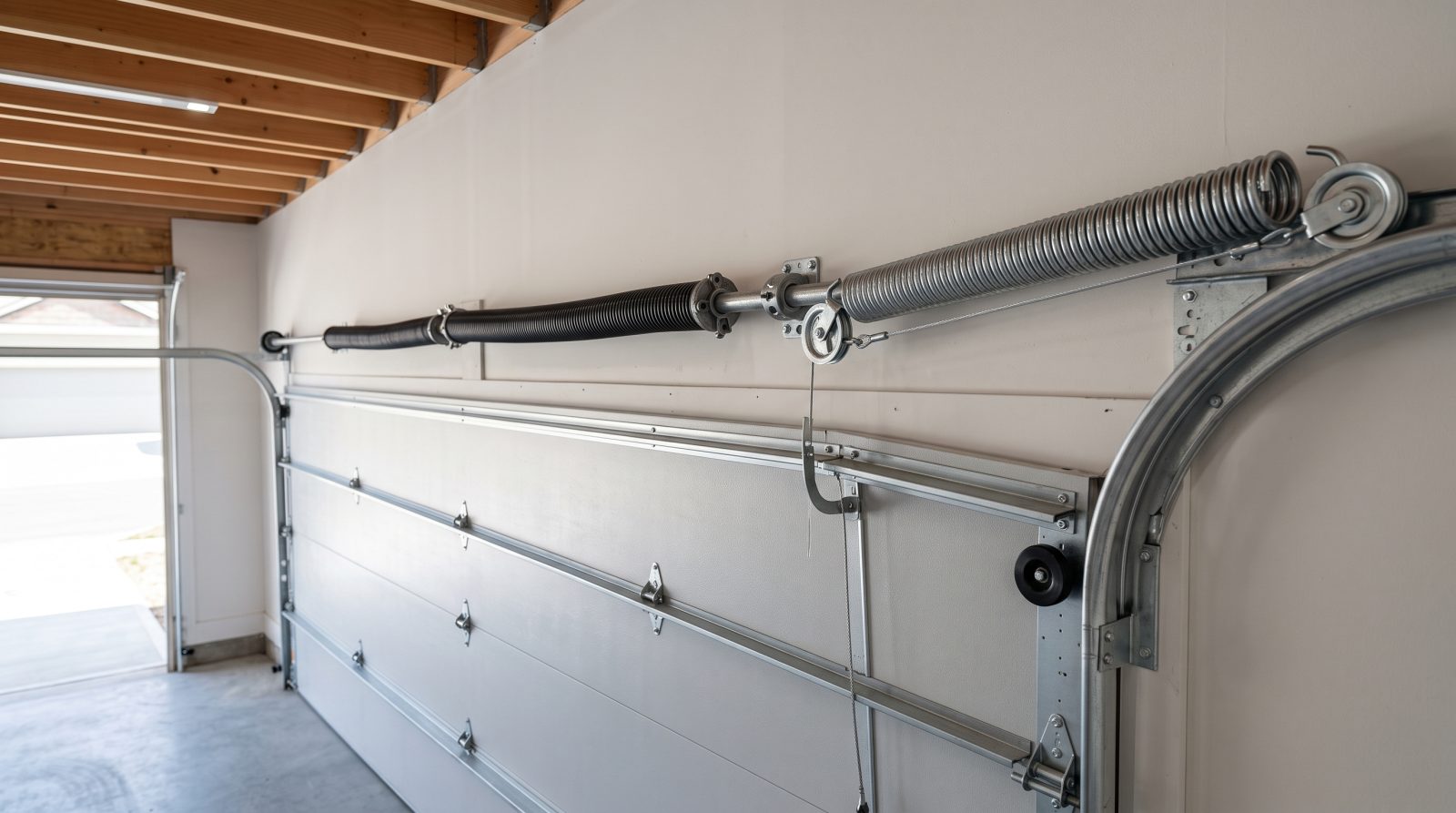
How Garage Door Springs Actually Work
A garage door is heavy. A standard double door in a Sacramento home can weigh anywhere from roughly 130 to over 350 pounds depending on whether it's a lightweight aluminum panel or an insulated steel door built to handle our triple-digit summer heat. The opener motor doesn't do the heavy lifting most people assume it does. Its job is mainly to guide the door up and down. The springs are what actually counterbalance the weight, storing mechanical energy when the door is closed and releasing it to help raise the door.
Because the spring is doing that much work, it's under tremendous tension at all times. When a spring is balanced correctly, you should be able to lift the door manually with one hand and it should hold its position halfway up. When a spring breaks or weakens, that balance disappears: the door feels like it weighs hundreds of pounds, the opener strains or refuses to move it, and the safety reverse may trip. Understanding which spring system you have is the first step in understanding why your door is behaving the way it is.
Torsion Springs: The Modern Standard
Torsion springs are the tightly wound coils mounted horizontally on a metal shaft above the garage door opening, usually centered over the door. Instead of stretching, they twist (torque) to store energy. As the door closes, cables wound around drums on each end of the shaft turn the shaft and wind the spring tighter; as the door opens, the spring unwinds and transfers that stored energy back through the cables to lift the door.
This design is the standard on most newer doors and on heavier insulated doors common in Sacramento new builds and remodels. Torsion systems run smoother and more controlled than extension systems, which means quieter operation, less bounce, and noticeably less wear on the opener, rollers, and tracks over time. Larger or heavier doors often use two torsion springs so the load is shared and balance is more precise.
The trade-off is cost and complexity. Torsion springs and their hardware typically run a bit more than extension springs, and they require specific winding bars and technique to install and tension safely. This is not a forgiving DIY job. The upside is a longer-lived, better-behaved door.
- Mounted on a shaft above the door; works by twisting, not stretching
- Smoother, quieter, and more controlled door travel
- Generally longer lifespan and easier on your opener and tracks
- Common on heavier insulated steel doors built for Sacramento heat
- Best balance for wide double doors, often using a pair of springs
Extension Springs: Common on Older Sacramento Homes
Extension springs are the long, lighter-gauge springs mounted along each horizontal track, running parallel to the ceiling on both sides of the door. They work by stretching: as the door closes, the springs extend and store energy, then contract to help pull the door up. You'll see one on the left and one on the right.
Extension springs are very common on older single-car garages and in many established Sacramento neighborhoods built decades ago, where lighter doors were the norm. They cost less than torsion systems and take up less headroom, which can matter in garages with low or obstructed ceilings.
The important safety point with extension springs is what happens when one breaks. Because the spring is stretched under load, a failure can send the spring and hardware flying across the garage. For that reason, extension springs should always have a safety cable threaded through the center, running from the track to the back of the system, to contain the spring if it snaps. If your door has extension springs and no safety cables, that's a real hazard worth fixing regardless of whether the spring is currently working.
- Mounted along the horizontal tracks on both sides of the door
- Work by stretching and contracting to counterbalance the door
- Lower up-front cost; use less overhead space
- Common on older and lighter single-car doors
- Must have safety cables installed to contain a broken spring
Lifespan, Wear, and What Sacramento Conditions Do to Springs
Garage door springs are rated in cycles, not years. One cycle is one full open-and-close. A standard spring is often rated around 10,000 cycles, while higher-quality springs can be rated for 20,000 cycles or more. How long that translates to in real life depends entirely on how often you use the door. A household that opens the garage four to six times a day can wear through a 10,000-cycle spring in well under a decade; a door used as the main family entrance wears faster.
Sacramento's climate adds its own stress. Our hot, dry summers and the day-to-night temperature swings cause the metal to expand and contract, and the dry air does springs no favors. Garages near the rivers or in lower-lying, more humid pockets can also see surface rust accelerate spring fatigue. Rust is a spring's enemy, because corrosion creates weak points where the coil eventually fractures.
A few simple habits extend spring life: keep the springs lightly lubricated with a garage-door-specific lubricant a couple of times a year, keep the door balanced, and don't ignore a door that's started moving unevenly or getting noisy. Those are early signals that the spring is fatiguing before it fails outright.
- Springs are rated by cycles (opens/closes), not by years
- Heavy daily use can wear a standard spring out in just a few years
- Sacramento heat, temperature swings, and dry air speed up fatigue
- Rust from humidity near the rivers creates fracture points
- Light lubrication twice a year and good balance extend spring life
Signs of a Failing Spring and Why You Shouldn't DIY It
The clearest sign of a broken torsion spring is a visible gap in the coil above the door, where the spring has snapped in two. With either type, you may also notice the door suddenly feels extremely heavy, the opener struggles or only lifts the door a few inches before stopping, the door drops fast or crooked, or you heard a loud bang from the garage (often mistaken for something falling). A door that won't stay open halfway when lifted by hand is also a strong sign the spring is out of balance.
Here's the part we never sugarcoat: spring replacement is the most dangerous garage door repair there is. A spring under tension stores enough energy to cause serious injury, and the winding bars, cones, and cables all have to be handled in the right sequence. Every year people are hurt attempting this with the wrong tools. We strongly recommend leaving spring work to someone who does it daily and carries the correct equipment.
One more practical note: when one spring on a two-spring door breaks, it's almost always worth replacing both. They've aged together and seen the same number of cycles, so the second one is usually not far behind. Replacing the pair saves you a second service visit and keeps the door balanced.
- Visible gap in the coil above the door (broken torsion spring)
- Door feels very heavy or the opener strains and stops short
- Loud bang from the garage, then the door won't open
- Door won't hold its position when lifted halfway by hand
- On two-spring doors, replace both springs at once for even balance
Which Spring Type Is Right for Your Door, and How We Help
For most Sacramento homeowners, especially anyone with a heavier insulated door or a wide double door, a torsion spring system is the better long-term choice. It's quieter, smoother, easier on the rest of the hardware, and generally lasts longer. Extension springs still make sense on lighter single-car doors, in garages with limited headroom, or when you're matching an existing setup on a budget, as long as proper safety cables are in place.
The right answer depends on your specific door's weight, width, track style, and available headroom, which is exactly why we diagnose springs in person rather than guessing. As a mobile garage door company, we come to your home anywhere in the Sacramento area, measure and weigh the door, confirm which spring type and cycle rating fits, and explain the options before any work starts. Some older doors set up for extension springs can even be converted to a torsion system for smoother, longer-lasting operation, and we'll tell you honestly whether that's worth it for your door.
If your spring has already broken, don't keep forcing the opener, as that can damage the motor and bend the tracks. Leave the door closed, keep people and cars clear, and request a free quote. We'll get you an accurate assessment and a clear, range-based estimate before we start.
- Torsion systems suit heavier, wider, and frequently used doors
- Extension springs fit lighter single-car doors and low-headroom garages
- We weigh and measure your door on-site to match the right spring and cycle rating
- Older extension setups can sometimes be converted to torsion for smoother life
- Stop running the opener on a broken spring to avoid further damage