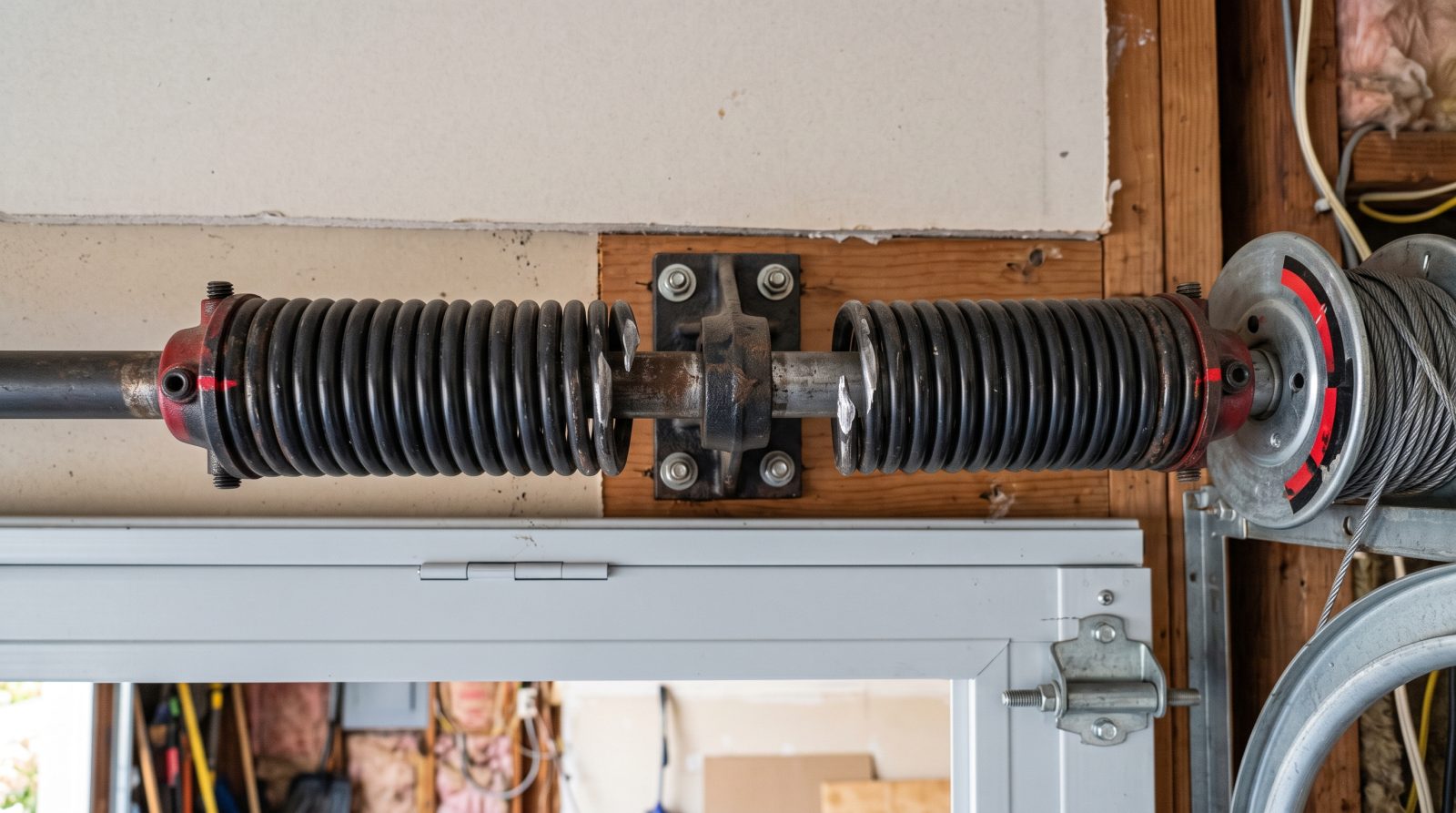
How Garage Door Springs Actually Work
Before you can recognize a broken spring, it helps to understand what the spring is doing. A garage door can weigh well over a hundred pounds, and the springs exist to counterbalance that weight so the opener motor (or your own arm) only has to manage a few pounds of effort. When the springs are healthy, the door feels almost weightless and glides smoothly. When a spring breaks, that counterbalance disappears instantly, and the full dead weight of the door drops onto the opener and the cables.
There are two main spring systems you will find on Sacramento homes. Torsion springs mount on a metal shaft along the wall directly above the door opening and wind up to store energy; they are the most common on modern double-car doors. Extension springs run along the horizontal tracks on either side of the door and stretch as the door closes. Knowing which system you have matters, because the failure signs look slightly different, but in both cases the loss of tension is the root problem.
Because springs are wound under enormous tension, they are also the most dangerous component in the whole door. That stored energy is what makes a clean diagnosis and replacement a job for a trained technician with the right winding bars and clamps rather than a weekend project.
- Torsion springs: mounted on a shaft above the door, common on heavier double doors
- Extension springs: stretch along the side tracks, common on lighter single doors
- Both store significant energy and lose counterbalance the instant they fail
- A healthy door should feel nearly weightless when lifted by hand
The Unmistakable Signs Your Spring Has Already Broken
Some symptoms are dead giveaways that a spring has snapped, and recognizing them quickly can prevent further damage to your opener, cables, and tracks. The most dramatic sign is a loud bang from the garage, often described as sounding like a firecracker or a gunshot. That sound is the spring failing under tension, and many homeowners only connect it to the door later when it will not open.
After a break, the behavior of the door changes immediately. The most common complaint we hear across Sacramento is that the door will only lift a few inches off the ground and then stops or slams back down. With a torsion spring, you may also see a clear gap in the spring coil above the door, as if someone cut a section out of it. The two halves will be separated by an inch or two where the metal split.
The door may also hang crooked or appear to come off its track on one side, which usually points to one extension spring breaking while the other still holds. And if you try the manual release and the door feels impossibly heavy, that weight is the tell: the springs are no longer carrying the load, so you are.
- A loud bang or pop from the garage, sometimes hours before you notice
- The door rises only a few inches with the opener, then stops or drops
- A visible gap or separation in the torsion spring coil above the door
- The door looks crooked, jammed, or partly off its track
- The door feels extremely heavy when you pull the manual release and lift by hand
Warning Signs That Come Before a Spring Breaks
Springs do not always fail without warning. Often there is a window of weeks or even months where a worn spring sends signals, and catching them early means a planned, scheduled repair instead of a stranded car and a stuck door on a workday morning. Pay attention to how your door sounds and moves over time, because gradual changes are easy to dismiss until it is too late.
Listen for new noises. A loud squeaking or grinding, or a harsh popping each time the door cycles, can mean the spring is fatiguing or that the coils are no longer winding smoothly. Watch the door's motion as well. If it starts to open more slowly than it used to, jerks or hesitates partway up, or seems to struggle where it once moved smoothly, the springs may be losing their strength.
A simple at-home check is the balance test, done with the opener disengaged: lift the door manually to about waist height and let go. A well-balanced door will mostly stay put. If it slams down or shoots up, the spring tension is off and the system is heading toward failure. Visible rust, gaps in the coils, or a spring that looks stretched and tired are also reasons to have it inspected. If you notice any of these, it is worth having a technician look before the spring lets go on its own.
- New squeaking, grinding, or popping noises during each cycle
- The door opens noticeably slower, jerks, or hesitates partway
- A failed balance test: the door slams shut or flies up when released at waist height
- Visible rust, stretched coils, or gaps forming in the spring
- The opener straining or working harder than it used to
Why Springs Fail Faster Around Sacramento
Garage door springs are rated by cycles, with each open-and-close counting as one cycle, and a standard spring is often rated for roughly 10,000 cycles. For a typical Sacramento household using the garage as the main entrance, parking two cars and coming and going several times a day, that lifespan can be reached in just a handful of years. The more your family uses the door, the sooner you should expect spring wear.
Our local climate adds its own stresses. Sacramento Valley summers bring long stretches of triple-digit heat, and that thermal cycling, hot days and cooler nights, expands and contracts the metal repeatedly, accelerating metal fatigue. Then the wet winters and Delta-influenced humidity roll in, and any spring that is not properly coated can develop surface rust. Rust increases friction between the coils and weakens the steel, which shortens spring life considerably.
Homes closer to the rivers and lower-lying neighborhoods can see more moisture exposure, while properties with detached or uninsulated garages feel the temperature swings even more sharply. Lack of routine lubrication compounds all of this. The good news is that periodic maintenance, lubrication, balance checks, and rust prevention, can meaningfully extend the life of a spring even in our climate.
- Standard springs are rated around 10,000 cycles, often a few years of daily use
- Hot Valley summers and cooler nights expand and contract the metal, fueling fatigue
- Wet winters and humidity promote rust that weakens and stiffens the coils
- Detached and uninsulated garages experience sharper temperature swings
- Skipping lubrication and maintenance shortens spring life significantly
Why Spring Repair Is a Job for a Pro, Not a DIY Project
It is tempting to treat a broken spring like any other home repair, but this is the one garage door component where doing it yourself is genuinely dangerous. A wound torsion spring stores a tremendous amount of energy, and releasing or installing it without the proper winding bars, clamps, and technique can cause the bars to fly loose or the spring to whip, leading to serious injuries to hands, face, and eyes. Every year people are hurt attempting this repair.
There is also a matter of getting it right. Springs must be matched precisely to the weight and size of your specific door, and they are wound to an exact number of turns. An undersized, oversized, or improperly wound spring will leave the door unbalanced, burn out your opener prematurely, or fail again quickly. In many cases, if you have two springs and one breaks, replacing both at the same time is the smarter move, since the second is usually close behind and matched replacement keeps the door balanced.
As a mobile garage door company, we come to you anywhere in the Sacramento area with the right springs and tools on the truck. A technician can confirm the diagnosis, measure your door, install the correct spring safely, retest the balance, and make sure the door cycles smoothly before leaving. Repair costs vary with the spring type, door size, and whether you replace one spring or both, so any figures you see online are industry ranges rather than a quote for your door. The fastest way to get an accurate, same-day answer is to request a free quote and let us assess the door in person.
- Wound springs store dangerous energy and require specialized winding bars and clamps
- Springs must be matched to your exact door weight, height, and cycle rating
- An improper spring leaves the door unbalanced and can burn out the opener
- Replacing both springs together is often smarter when one has already failed
- We bring the parts and tools to you anywhere in the Sacramento area for same-day service