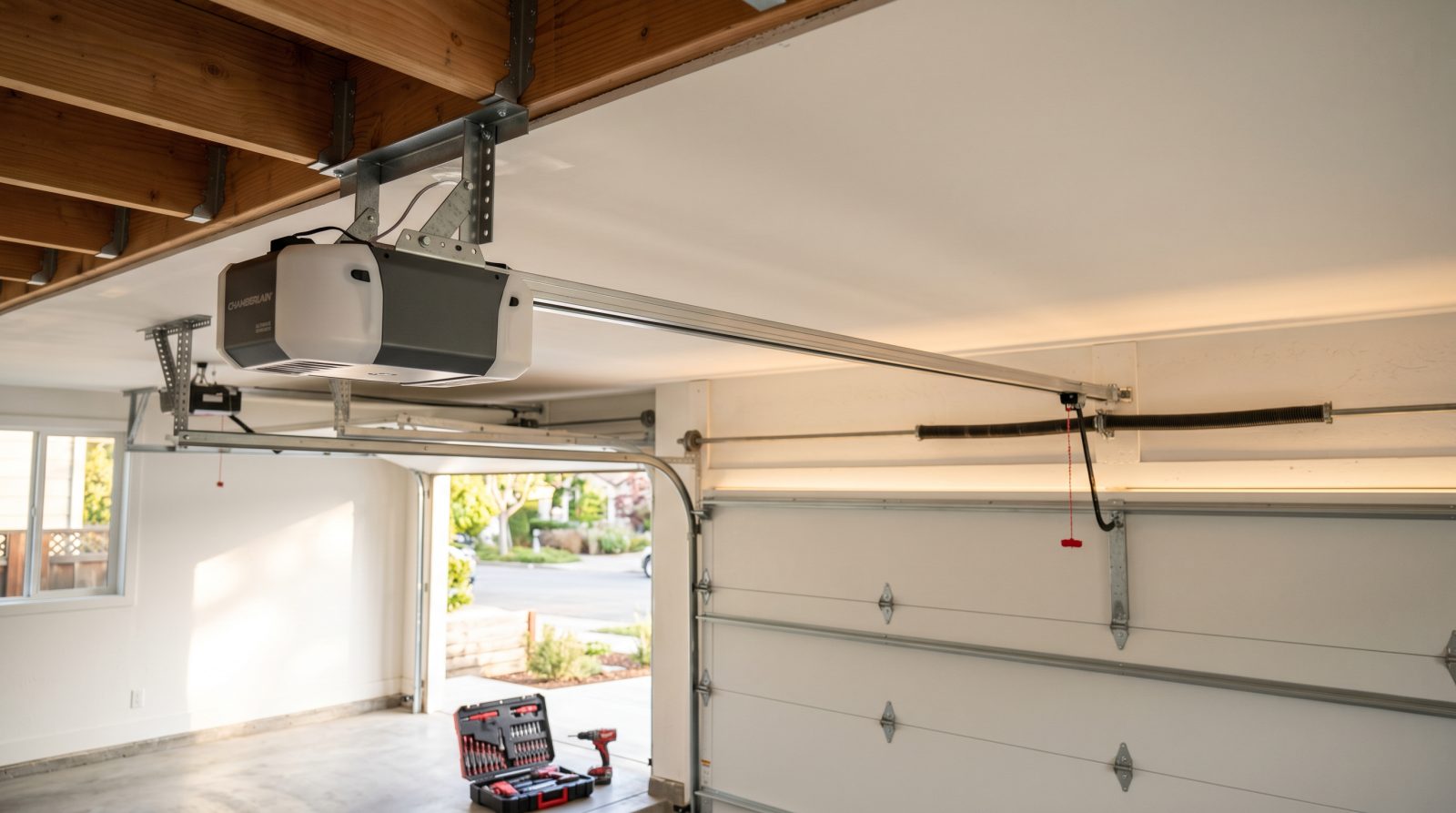
What a Professional Opener Installation Actually Includes
Replacing a garage door opener is more than bolting a motor to the ceiling and plugging it in. A proper installation starts with the door itself, because the opener only lifts a door that's already balanced. Before we mount anything, we disconnect the door from the old opener and lift it by hand. A healthy door should glide up smoothly and hold its position around chest height. If it's heavy, jerky, or drops on its own, that's a spring or balance issue, and installing a powerful new opener on top of it just hides a problem that will burn out the motor early. We'll tell you straight if the door needs attention first.
From there, the work is methodical: removing the old unit, assembling and mounting the new rail and motor head, securing the trolley and door arm, and anchoring the unit to solid framing rather than just drywall. We set the travel limits so the door closes fully without slamming and opens without straining, then we calibrate the force settings. Federal safety rules require automatic doors to reverse on contact, so we test the auto-reverse on a solid object and confirm the photo-eye safety sensors near the floor are aligned and working before we consider the job finished.
Because we're mobile, the whole process happens at your home. There's no dropping the door off anywhere and no waiting on a shop. We come to you, do the install in your garage, program your remotes and wall control, and walk you through how to use it, including the emergency release cord in case the power ever goes out. You watch it work before we leave.
- Door balance and spring check before any opener goes up, so the motor isn't fighting a bad door
- Removal and disposal of the old opener unit
- New rail, motor, trolley, and reinforced mounting to solid framing
- Travel-limit and force calibration so the door seals at the bottom without slamming
- Safety verification: auto-reverse test plus photo-eye sensor alignment
- Remote, keypad, and wall-control programming, with a hands-on walkthrough
Chain vs. Belt vs. Screw Drive: Which Opener Is Right for You
The biggest decision in a new opener is the drive type, because it determines how loud the door is, how much maintenance it needs, and how it holds up to Sacramento's climate. There's no single best choice; the right one depends on your garage layout and how you live with it.
Chain drive is the workhorse. A metal chain pulls the door along the rail, the same mechanism that's been reliable for decades. It's the most economical option and handles heavy doors well, which makes it a sensible pick for a detached garage where noise doesn't travel into bedrooms. The trade-off is sound: chain units have a distinct rattle and hum, and that matters a lot in the older central neighborhoods like Land Park, Curtis Park, and Midtown, where garages are often close to or under living space.
Belt drive swaps the chain for a reinforced rubber belt. It does the same job far more quietly, with almost no vibration, which is why it's the go-to for attached garages and any home with a bedroom, office, or bonus room over or beside the garage. It costs more than a chain unit, but for a lot of Sacramento homeowners the quiet is worth it, especially in newer attached-garage builds in Natomas, Folsom, Roseville, and Elk Grove where the garage shares walls with the house.
Screw drive uses a threaded steel rod to move the door, with fewer moving parts and a middle-ground noise level. Its reputation for struggling in temperature extremes was earned by older designs; modern self-lubricating screw drives handle our hot Central Valley summers far better. It can be a solid, low-maintenance option, though for sheer quiet a belt still wins, and for raw value a chain still wins. We'll match the drive to your specific garage rather than upselling you on features you won't use.
- Chain drive: lowest cost, very durable, but the noisiest. Best for detached garages and shops
- Belt drive: quietest and smoothest, costs more. Best for attached garages and rooms over the garage
- Screw drive: fewer parts, mid-range noise, low maintenance. Modern units handle Sacramento heat well
- Heavier doors (solid wood, insulated, oversized) benefit from higher-horsepower motors regardless of drive
- If your garage sits under a bedroom, lean belt; if it's a separate building, chain saves money with no downside
Smart Openers: What They Actually Do (and What's Worth Paying For)
Most new openers we install now are Wi-Fi enabled, and the convenience is genuinely useful rather than gimmicky. From an app on your phone you can see whether the door is open or closed, open or close it from anywhere, and get an alert if it's been left open. For anyone who has driven halfway to work in Sacramento traffic wondering if the garage is open, that peace of mind alone is the selling point. You can also grant temporary access to a house cleaner, a dog walker, or a relative without handing out a physical remote.
The practical wins go further. Smart openers let you set a rule that auto-closes the door if it's been open past a set time, which is a real benefit on hot afternoons when an open garage bakes everything inside and invites pests. Many integrate with delivery services so a courier can drop a package securely inside, and most work with the smart-home systems people already use. If you've added an EV and a charger in the garage, the connected door fits naturally into that routine.
A few honest caveats. Smart features depend on your home Wi-Fi reaching the garage, and in some detached garages or homes with thick walls the signal is weak, which is worth checking before you count on the app. Some brands also gate certain features, like camera integration, behind a subscription, so it's smart to know what's free and what's monthly before you buy. We'll walk you through which features come standard on the units we install and help you connect it to your network during the install, so you leave with it working, not with a setup project waiting on the kitchen table.
- Open, close, and check status from your phone anywhere, with left-open alerts
- Scheduled auto-close, useful in Sacramento summers when an open garage overheats
- Temporary digital access for guests, cleaners, and deliveries without extra remotes
- Works with common smart-home setups and pairs naturally with an EV garage routine
- Reality check: needs solid Wi-Fi in the garage; some camera features may require a subscription
Signs It's Time to Replace, Not Repair
Sometimes a noisy or balky opener just needs a tune-up or a single part. Other times you're pouring money into a unit that's near the end of its life. A good rule of thumb is age: most openers run well for roughly 10 to 15 years, and once a unit is past that window, repairs start stacking up and replacement parts get harder to find. If yours predates safety sensors entirely (units made before the early 1990s often lack the photo-eyes near the floor), replacing it is also a meaningful safety upgrade for any household with kids or pets.
Performance tells you a lot too. An opener that runs loud and shakes the whole garage, hesitates before it moves, reverses for no reason, or responds inconsistently to the remote is showing its age. So is one that can no longer keep up with a door you've made heavier, say after adding insulation or switching to a solid wood door. And if you simply want app control, scheduled closing, and quieter operation, replacing an aging unit with a modern belt-drive smart opener is often more satisfying and cost-effective than chasing repairs on the old one.
Because we come to you, a replacement assessment is easy. We can look at the door, the springs, and the existing unit in your driveway, give you a straight answer on whether a repair makes sense, and quote a replacement on the spot if that's the better call. No pressure either way.
- Unit is past roughly 10 to 15 years and repairs are adding up
- No photo-eye safety sensors (typically pre-1993 openers), a real safety gap
- Loud, shaky operation, hesitation, or random reversing
- Door has gotten heavier (insulation, solid wood) and the motor is straining
- You want quiet operation, smart-phone control, or scheduled auto-close
Honest Cost Ranges and Why Mobile Service Saves You
Garage door opener pricing depends on the drive type, the motor's horsepower, whether it's a smart unit, and whether your door needs any balance or spring work first. As a general industry guide, basic chain-drive openers sit at the lower end, belt-drive and smart units cost more, and high-horsepower motors for heavy or oversized doors run higher still. These are labeled ranges to help you plan, not a quote; the only accurate number is one based on seeing your actual door and garage. We'll give you a clear, itemized price before any work starts, with no surprises tacked on at the end.
Installation labor is part of the picture, and this is where mobile service has a real edge. There's no shop overhead baked into the price and no separate trip charge stacked on top of a storefront markup, because the work simply happens in your garage. We carry common openers and the mounting hardware on the truck, so in most cases we can assess and install in the same visit rather than scheduling a second trip. For most Sacramento-area homeowners, a straightforward opener swap is a same-day job.
If your door turns out to need a spring or balance fix before the new opener goes in, we'll explain exactly why and what it costs before touching it, since high-tension springs are dangerous and not a DIY repair. The goal is a door and opener that work together for years, not the cheapest install that fails early. Request a free quote and we'll come out, look at what you've got, and give you honest options.
- Chain drive: most budget-friendly; belt and smart units cost more; high-horsepower motors for heavy doors run higher (industry ranges, not a quote)
- Mobile means no storefront overhead and no separate trip fee built into the price
- Common openers and hardware ride on the truck, so most installs are same-day
- Any required spring or balance work is explained and priced before we start
- You get a clear, itemized price up front, after we see your door