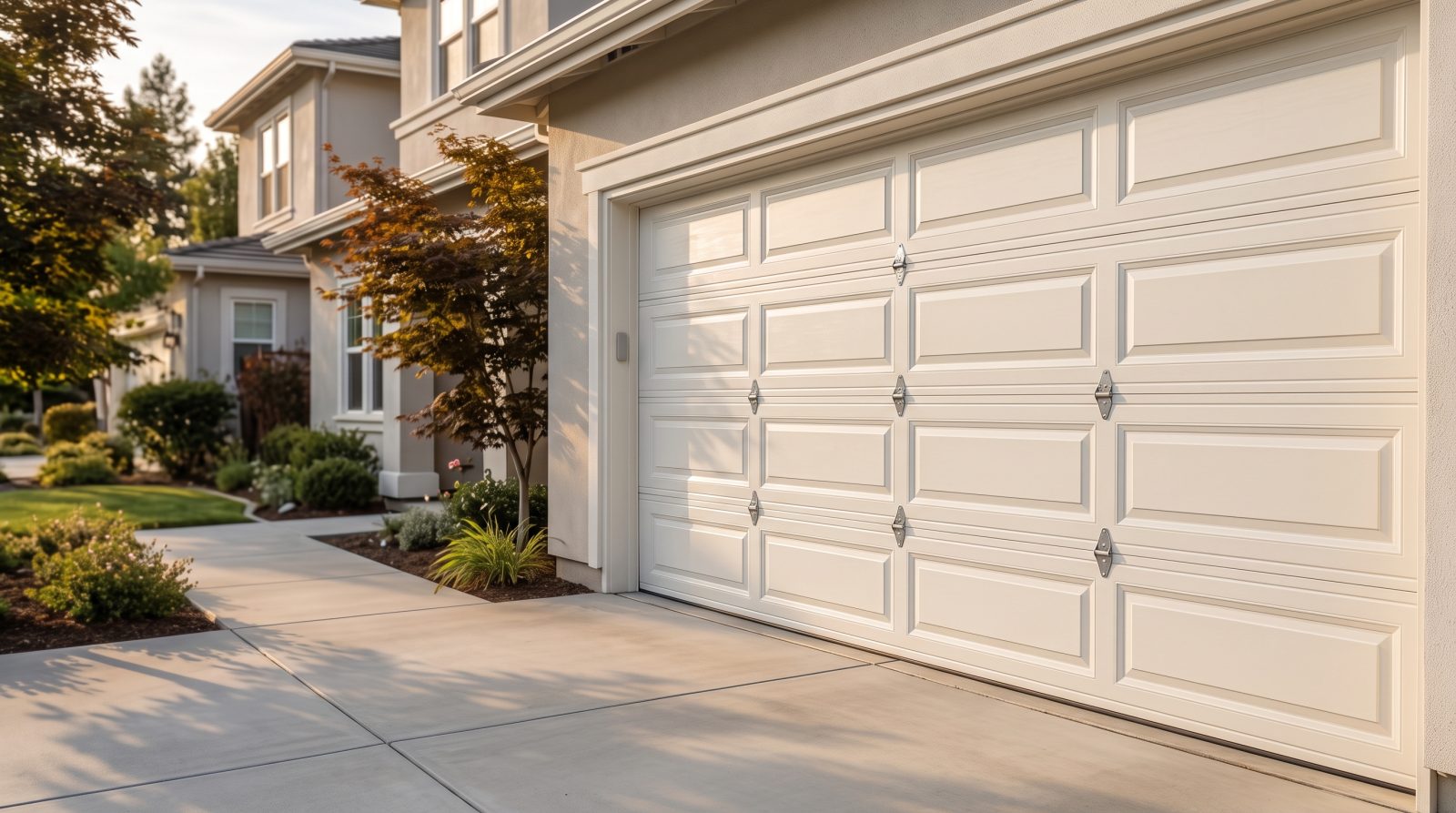
What a Sectional Garage Door Actually Is
A sectional garage door is built from several horizontal panels, usually four or five, hinged together so the whole assembly can flex. Instead of swinging out as one rigid slab (the way an old tilt-up or 'one-piece' door does), each panel pivots independently as the door travels. Rollers on the edge of every panel ride inside steel tracks mounted on both sides of the opening. As the door lifts, those tracks curve from vertical to horizontal near the ceiling, so the panels bend around the curve and end up resting flat and parallel above your car.
Because the door stores horizontally overhead rather than swinging into the driveway, a sectional door is the right fit for the way most Sacramento homes are laid out, including short driveways on infill lots and garages that sit close to the sidewalk. It also seals tightly against the opening on all four sides, which matters a great deal here when summer heat is trying to bake an attached garage and your HVAC is working overtime.
The panels themselves are typically steel (often with a foam core for insulation), though you'll also see aluminum-and-glass contemporary doors, composite, and real-wood or wood-look doors on higher-end remodels around East Sacramento and the Fab 40s. Whatever the skin, the mechanical guts are the same family of parts, which is what makes them straightforward for a mobile tech to diagnose on-site.
- Multiple hinged panels (usually 4-5) instead of one solid slab
- Rollers ride in vertical tracks that curve to horizontal near the ceiling
- Door stores flat against the garage ceiling, freeing up driveway space
- Common skins: insulated steel, aluminum-and-glass, composite, and wood/wood-look
How the Mechanics Work: Springs, Cables, Tracks, and Opener
Here is the part most homeowners never see: your garage door opener is not what lifts the door. A sectional door can weigh well over a hundred pounds, and a typical opener motor is far too small to hoist that much dead weight day after day. The real lifting is done by the spring system, which counterbalances the door's weight so it feels nearly weightless. The opener just nudges that balanced door up and down.
Most Sacramento sectional doors use a torsion spring, the tightly wound spring mounted on a steel shaft above the door opening. As the door closes, the spring winds up and stores energy; as it opens, that energy is released to help lift. Lift cables run from the bottom corners of the door up to drums on the ends of that shaft, transferring the spring's force to the door. Some older or lighter doors instead use extension springs that stretch along the horizontal tracks. Either way, the spring is the single most important and most highly stressed component in the entire system.
The tracks and rollers keep everything aligned and let the panels make that vertical-to-horizontal turn smoothly. Hinges connect the panels and carry the rollers. The opener adds the automation and the safety reversal: photo-eye sensors near the floor stop and reverse the door if something crosses the beam. When a sectional door is working right, all of these parts share the load in balance, and the door glides quietly. When one part falls out of spec, the strain cascades to the others, which is why a small unaddressed issue often becomes a bigger repair.
- Springs (usually torsion) carry the weight; the opener only guides the door
- Lift cables transfer spring force from the shaft drums to the door's bottom corners
- Tracks, rollers, and hinges keep the panels aligned through the curve
- Photo-eye safety sensors reverse the door if anything is in its path
Why Sectional Doors Are the Right Choice for Sacramento Homes
Sacramento's climate is hard on a garage in two specific ways, and a well-built sectional door answers both. First is the heat. Triple-digit valley summers turn an uninsulated attached garage into an oven that bleeds into the rest of the house. An insulated sectional door with a foam core and good perimeter weatherstripping is one of the most cost-effective ways to keep that heat out, especially on west- and south-facing garages that take the full afternoon sun. Second is the dust and the swing between hot days and cool Delta-breeze nights, which expands and contracts metal parts and works fasteners loose over time.
Sectional doors also suit how Sacramento neighborhoods are built. On tight Midtown and Land Park lots, a door that stores overhead instead of swinging outward means you can park right up to the door without it hitting your bumper. For the deep garages and tall ceilings common in newer Roseville, Folsom, and Elk Grove construction, there's room for high-lift or vertical-lift track configurations that maximize overhead storage. And because the door seals on all four sides, it does a better job keeping out the fine valley dust and the occasional winter rain that drives sideways off the Sierra.
Finally, sectional doors are simply the standard, which works in your favor. Parts are widely available, the configurations are well understood, and a mobile technician can carry the springs, rollers, hinges, cables, and weatherstripping needed for the vast majority of jobs right in the truck. That means most repairs and tune-ups can be handled in a single same-day visit at your home.
- Insulated panels and tight seals fight triple-digit summer heat gain
- Overhead storage fits tight Midtown, Land Park, and infill-lot driveways
- High-lift and vertical-lift options suit tall garages in Folsom, Roseville, and Elk Grove
- Industry-standard parts mean most fixes are doable on-site in one visit
Common Sectional Door Problems We See Across the Sacramento Area
Because the spring carries the load, it's also the part that wears out first. Springs are rated for a finite number of cycles (one open plus one close equals one cycle), and a busy household that uses the garage as its main entrance can exhaust a standard spring in just a few years. A broken torsion spring is the classic 'my door won't open and there's a loud bang in the garage' call. When that happens, the door is suddenly carrying its full weight with no counterbalance, so do not try to force it open or run the opener, which can burn out the motor or damage panels.
After springs, the most frequent issues are frayed or snapped lift cables, worn rollers that make the door grind and shudder, bent or misaligned tracks (often from a bumper tap or a settling foundation), and loose or cracked hinges. Sacramento's heat and dust also dry out and crack the bottom weather seal, which lets in hot air, water, and the occasional uninvited critter. On the automation side, we see misaligned photo-eye sensors that cause the door to refuse to close and reverse for no apparent reason, plus aging openers that struggle in the heat.
A panel itself can also be damaged, whether it's a dent from a basketball or backing into the door, water staining on a wood door, or rust starting at the bottom edge of an older steel door. The good news is that sectional construction means a single damaged panel can often be replaced without scrapping the whole door, provided the model and panel style can be matched. We assess that on-site and tell you honestly whether a panel swap or a full door makes more sense.
- Broken torsion or extension springs (the most common no-open failure)
- Frayed or snapped lift cables and worn, noisy rollers
- Bent or misaligned tracks from impacts or foundation settling
- Cracked bottom seals, misaligned safety sensors, and aging openers
- Dented or weathered panels, which can sometimes be replaced individually
How Our Mobile Service Works and What Repairs Typically Cost
We are a fully mobile garage door operation, which means there is no shop for you to visit and no door to transport. You request a free quote, we come to your driveway anywhere across the Sacramento area, and we diagnose the door right where it hangs. For most sectional-door issues, we carry the common springs, cables, rollers, hinges, and weatherstripping on the truck, so a typical repair or safety tune-up is handled same-day in a single visit. We'll walk you through what we find before any work starts.
Cost depends on the part and the door, and it's important to treat any number you see online as a general industry range, not a quote for your specific door. As a rough guide, spring replacements commonly fall in the low-to-mid hundreds of dollars depending on whether you replace one or both and the spring's size and cycle rating; roller and cable jobs are usually lower; full opener replacement runs higher; and replacing a single damaged panel varies widely with the door's brand, style, and finish. Insulated, custom, and wood-look doors sit at the upper end. The only way to get an accurate figure is an on-site look, which is exactly why the quote is free.
When we service a sectional door, we don't just swap the broken part and leave. We check the balance, inspect the cables and rollers, test the safety reversal and photo-eyes, tighten hardware, and lubricate the moving parts so the whole system shares the load the way it's meant to. That's the difference between a quick patch and a door that keeps running quietly through another Sacramento summer.
- Fully mobile: we come to your home anywhere in the Sacramento area
- Common springs, cables, rollers, and hinges stocked on the truck for same-day fixes
- Costs vary by part and door; figures online are industry ranges, not quotes
- Every visit includes a balance check, safety test, and full-system lubrication
- Call or request a free, no-obligation on-site quote