Start With Your Door, Not the Opener
The single most common mistake homeowners make is shopping for an opener before understanding the door it has to lift. An opener does not carry the weight of your door on its own. A correctly balanced door is held in tension by its springs, and the opener simply guides it up and down. If your springs are worn or mismatched, even the most powerful opener will strain, overheat, and die early. Before you spend a dollar on a new opener, the door should be checked for balance: disconnect the opener, lift the door halfway by hand, and let go. A balanced door stays roughly in place. A door that slams down or shoots up is telling you the springs, not the motor, are the problem.
Door material and size drive how much lifting force you actually need. A lightweight single-car aluminum or thin steel door is gentle on any opener. A wide double door, a solid-wood carriage-house door, or an insulated multi-layer steel door common on newer Sacramento builds weighs far more and benefits from a stronger, smoother motor. Measure your door's width and note whether it is a standard 7-foot-tall door or a taller 8-foot door, which many Natomas, Elk Grove, and Roseville garages have, because taller doors need an extended rail kit that not every opener includes in the box.
Finally, look up. The space above the door and along the ceiling determines which opener styles will even fit. Low headroom, exposed trusses, storage racks, and ductwork all change the answer. This is exactly the kind of thing a mobile measurement visit settles quickly, so you are not returning a too-short rail or discovering a clearance problem mid-install.
- Test door balance before buying: a healthy door holds position when lifted halfway by hand
- Heavier doors (solid wood, insulated double-layer steel) reward a stronger, smoother opener
- Confirm door height: 8-foot doors need an extended rail kit many openers sell separately
- Check ceiling clearance and obstructions before committing to a drive style
Drive Types: Belt, Chain, Screw, and Jackshaft
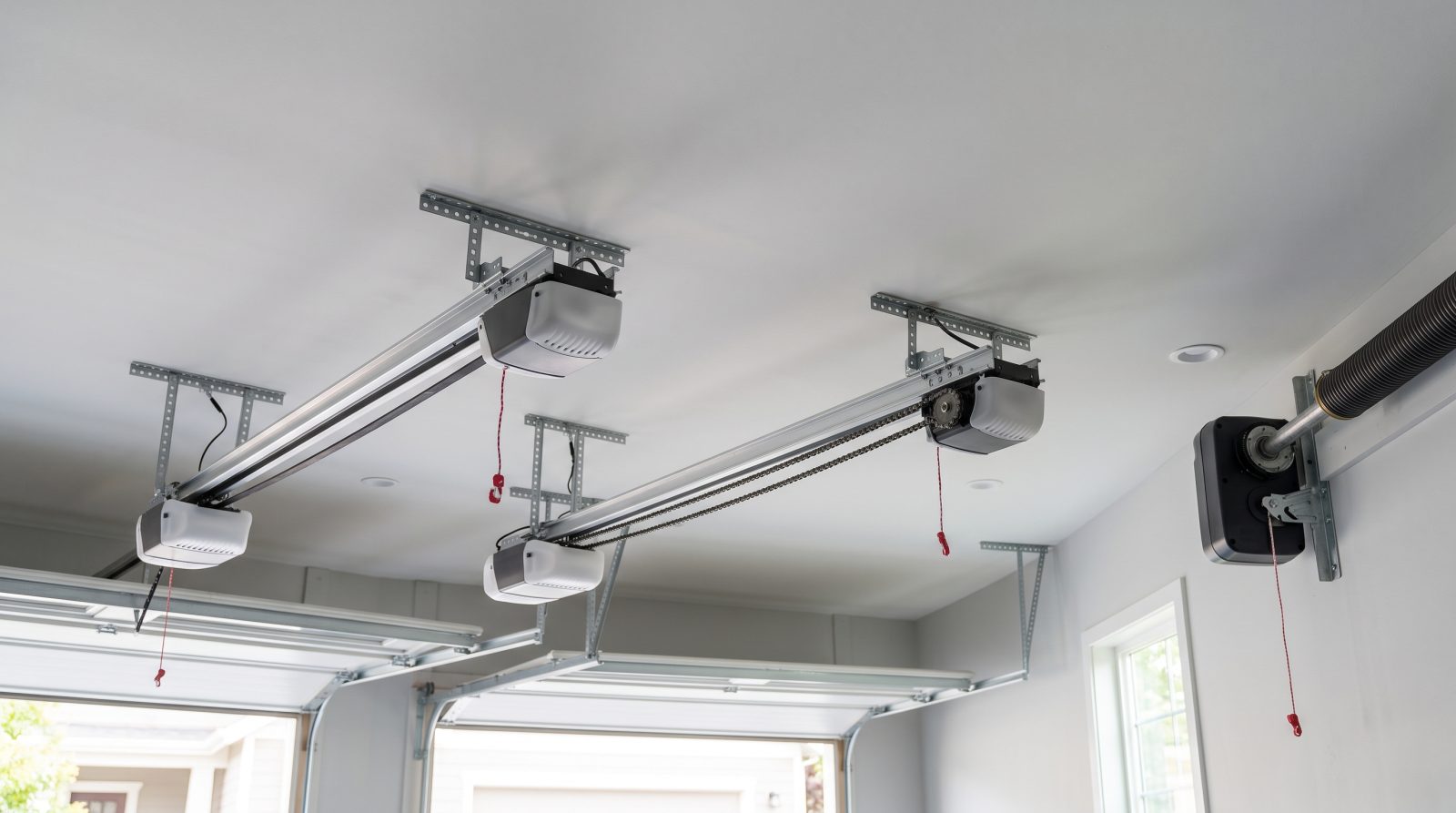
The drive type is how the opener moves your door, and it is the decision homeowners feel every single day in noise and smoothness. Belt drive uses a reinforced rubber belt and is the quietest option by a wide margin. If your garage shares a wall or ceiling with a bedroom, home office, or nursery, which describes a huge share of Sacramento's attached-garage tract homes, belt drive is almost always worth the modest extra cost. It runs so smoothly that many homeowners are surprised the door is already open.
Chain drive uses a metal chain, similar to a bicycle chain, to pull the door along the rail. It is the most affordable and extremely durable, which is why it has been the workhorse of garages for decades. The trade-off is noise and a bit more vibration. For a detached garage, a shop, or a home where no one sleeps near the garage, chain drive is a sensible, long-lasting value. Screw drive uses a threaded steel rod that the trolley rides along. It has fewer moving parts and decent speed, but the threaded rod can be sensitive to temperature swings. In Sacramento's wide seasonal range, from cold Delta-fog mornings to 100-plus-degree afternoons, screw-drive units want periodic lubrication to stay smooth, so factor that maintenance in.
Jackshaft openers are the specialty option. Instead of a rail along the ceiling, they mount on the wall beside the door and turn the torsion bar directly. They are ideal for garages with very low headroom, vaulted or finished ceilings, or homeowners who want the ceiling completely clear for storage or a lift. They cost more and require a torsion-spring door setup, but for the right garage they solve problems no rail-mounted opener can.
- Belt drive: quietest, best for garages under or beside living space; the top pick for attached homes
- Chain drive: lowest cost, very durable, noisier; great for detached garages and shops
- Screw drive: fewer parts, needs regular lubrication to handle Sacramento's temperature swings
- Jackshaft: wall-mounted, frees the ceiling, ideal for low-headroom or finished-ceiling garages
Horsepower, Motor Type, and Speed
Horsepower ratings tell you how much lifting force an opener can deliver, but bigger is not automatically better. The goal is matching force to door weight so the motor works comfortably rather than at its limit. A common single-car door pairs well with a 1/2 HP-class opener. A standard insulated double door is happiest with a 3/4 HP-class unit, which lifts confidently without the strain that shortens a motor's life. Very heavy carriage-style or oversized doors may call for a 1-1/4 HP-class opener. Choosing slightly more capacity than the minimum gives you quieter, longer-lasting operation, especially as a door ages and its springs gradually weaken.
Just as important as the number is the motor type. Older openers used AC motors that run at one fixed speed and start and stop abruptly. Newer DC motors offer soft start and soft stop, meaning the door eases into motion and slows before it seats. That gentleness reduces noise and vibration dramatically and is easier on the whole door system over years of cycles. DC motors are also more compact and pair naturally with battery backup. If quiet, smooth operation matters to you, prioritize a DC motor as much as the horsepower rating.
Speed is the last piece. Most residential openers move the door at a comfortable, safe pace, with premium models opening a bit faster. For most Sacramento homeowners the difference is small, but if you have a long commute and value shaving a few seconds in the morning, or you simply dislike waiting in the heat, a faster DC opener is a nice quality-of-life upgrade rather than a necessity.
- Single door: 1/2 HP-class is typically sufficient
- Insulated double door: 3/4 HP-class for confident, quieter lifting
- Oversized or solid-wood doors: 1-1/4 HP-class for headroom on force
- Favor DC motors with soft start/stop for quiet operation and a gentler load on the door
Features That Actually Matter in Sacramento
Battery backup has moved from a luxury to something many Sacramento homeowners genuinely want. When summer heat strains the grid or a winter storm knocks out power, a battery-backup opener still raises and lowers your door, so you are never stranded outside or trapped in the garage. In California, battery backup is now standard on new residential opener installations, and it is one of the features people are most thankful for the first time the lights go out. If you are replacing an older unit, this alone can justify the upgrade.
Smart connectivity is the other feature worth real attention. Wi-Fi-enabled openers let you check whether the door is closed, open or close it from your phone, and get alerts if it is left open, which is reassuring when you are already at work in downtown or stuck in traffic on the causeway. Many models support guest access codes for deliveries or housekeepers and integrate with smart-home systems. Pair this with a modern photo-eye safety sensor system and rolling-code remotes, which generate a new code with every use so the signal cannot be copied, and you have meaningfully better security than a decade-old opener offered.
A few practical extras round out a good buy. Integrated LED lighting brightens the garage far better than a single old bulb, useful in a space that often doubles as a workshop or laundry area. An automatic-close timer ensures the door is never accidentally left open on a hot day, an open invitation in any neighborhood. And a quality wall-mounted control panel with a lock feature and a manual-release that is easy to reach keeps daily use simple and safe for the whole household.
- Battery backup: keeps the door working during outages and is now standard on new California installs
- Wi-Fi control and alerts: open, close, and confirm door status from your phone anywhere
- Rolling-code remotes and modern photo-eye sensors: stronger security and safer reversal
- LED lighting and auto-close timer: a brighter garage and peace of mind on hot Valley days
Installation, Cost Ranges, and When to Call a Pro
A new opener is one of the more involved home projects because it ties into your door's safety systems. The photo-eye sensors must be aligned precisely so the door reverses if anything crosses its path, the travel limits and force settings must be tuned so the door closes fully without slamming or reversing, and the unit must be securely mounted to framing that can handle repeated cycles. A misadjusted opener is not just annoying; it is a safety hazard, particularly with children and pets around. This is the part of the job where professional installation pays for itself.
On cost, it helps to think in labeled industry ranges rather than a single quote, because the right number depends on the drive type, horsepower, features like battery backup, and whether old equipment needs removal or any wiring updates are required. As a general guide, basic chain-drive units sit at the lower end of the range, quiet belt-drive and DC-motor models with smart features and battery backup sit higher, and jackshaft openers for specialty garages are typically the most. Installation labor is separate from the unit itself. These are industry ranges to set expectations, not a price for your home; the only way to know your number is a look at your specific door and garage.
Because we are a mobile garage door company, we bring the assessment and the install to you anywhere in the Sacramento area, from Midtown bungalows to newer subdivisions in Folsom, Roseville, and Elk Grove. We can measure your door, confirm clearance and door height, check that your springs are healthy enough to pair with a new opener, and recommend the drive type and features that fit your garage and budget. If you are weighing options, the simplest next step is to call or request a free quote and let us match the opener to your actual door rather than guessing in a store aisle.
- Proper sensor alignment and travel/force tuning are safety-critical and best done by a pro
- Cost varies by drive type, horsepower, features, and removal of old equipment (industry ranges, not quotes)
- Basic chain drive is lowest; quiet belt/DC with battery backup is higher; jackshaft is typically the most
- Mobile service comes to you across Sacramento to measure, advise, and install, often same-day