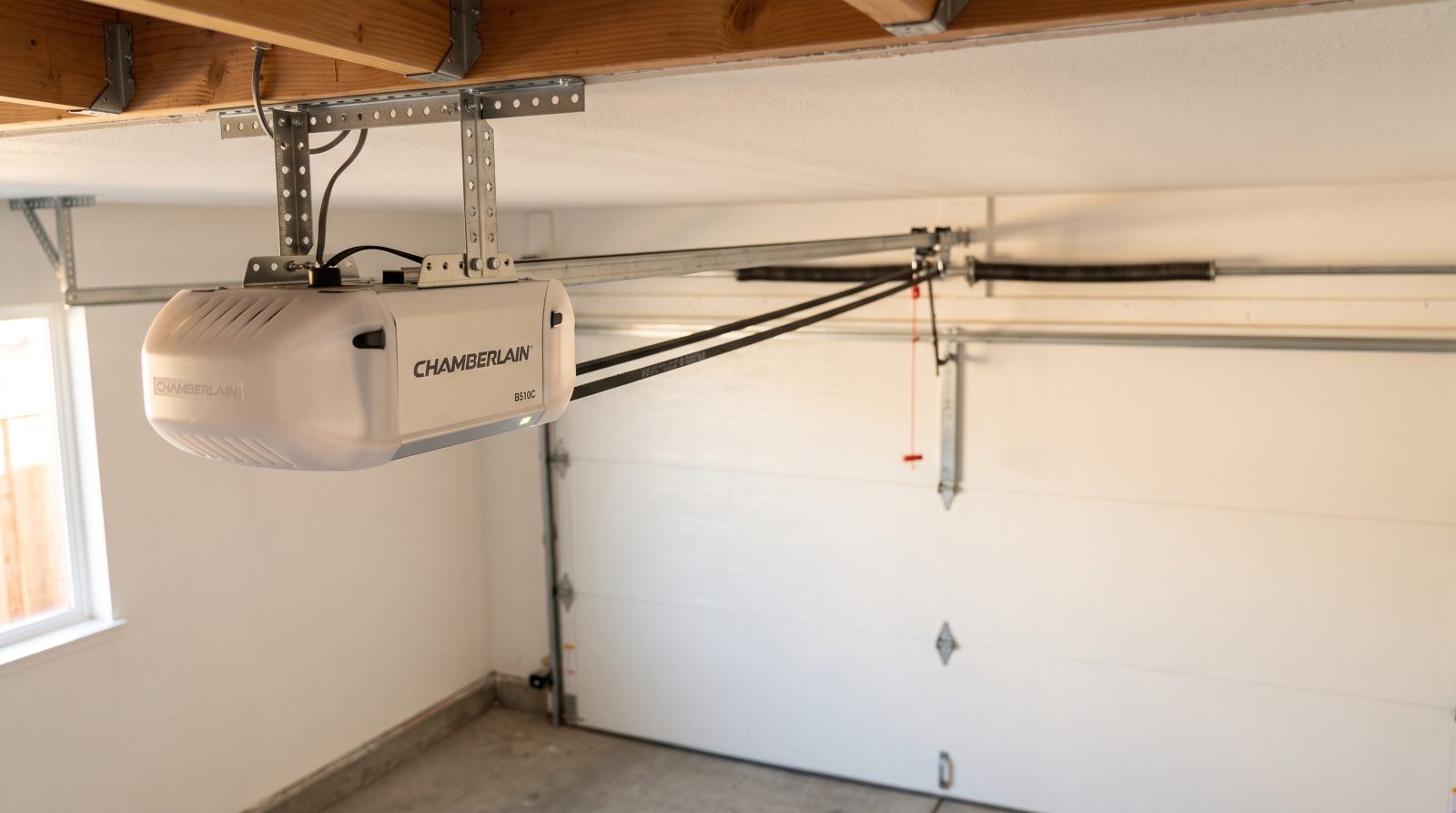
Garage Door Opener Cost in Sacramento: The Price Ranges
The most useful way to think about opener cost is in two parts: the opener unit itself, and the labor to install and program it. As a general industry range, the opener unit alone typically runs from roughly $150 to $600 depending on drive type and features, and professional installation usually adds about $150 to $350 in labor. Bundled together, most Sacramento homeowners replacing a standard single or double-door opener land somewhere in the range of $350 to $800 installed for a quality mid-tier unit, with premium smart and heavy-duty models pushing higher.
These are honest planning ranges drawn from typical residential work, not a fixed price. The right number for your home depends on the specifics covered in the sections below: which drive system you pick, how heavy your door is, and whether your garage already has the wiring, outlet, and structural support a new opener expects. Because we operate mobile and come to you, you also avoid the markup and trip-to-the-store hassle of sourcing a unit yourself, and we can match the opener to your exact door weight on site.
Sacramento's mix of housing stock matters here too. A 1950s ranch in Tahoe Park, a two-story in Natomas, and a newer build in Elk Grove can all need different horsepower and rail lengths, which is why a walk-up look at your actual door is the only way to firm up a true cost.
- Opener unit only (industry range): roughly $150-$600 depending on drive type and features
- Professional installation labor (industry range): roughly $150-$350
- Typical mid-tier opener installed: roughly $350-$800 for a standard residential door
- Premium smart / heavy-duty (8-foot or solid-wood doors): commonly higher than the standard range
- All figures are labeled industry ranges, not quotes; request a free quote for an exact price
What Drives the Price: Drive Type, Horsepower & Features
The single biggest factor in opener cost is the drive system, and each type fits a different priority. Chain-drive openers are the workhorse budget option and tend to sit at the lower end of the unit range; they're durable and reliable but the metal-on-metal operation is noticeably louder, which matters if a bedroom sits above or beside the garage. Belt-drive openers cost more but run far quieter using a reinforced rubber belt, making them the popular choice for attached garages and two-story homes. Screw-drive and the newer wall-mounted (jackshaft) units occupy the upper end, with wall-mounted models freeing up ceiling space and excelling on tall or heavy doors.
Horsepower (or its DC equivalent) is the next lever. A standard single steel door is usually well served by a 1/2 HP class motor, while heavier double doors, insulated doors, or solid-wood carriage doors common on some Sacramento custom homes call for 3/4 HP or more. Pushing an underpowered motor on a heavy door shortens its life, so sizing it correctly is part of getting honest value rather than the cheapest sticker.
Features round out the price. Battery backup, which keeps your door working during a power outage, is genuinely worth considering given our summer grid strain and occasional outages, and many newer units now include it as a standard feature. Smart Wi-Fi control, built-in cameras, smartphone alerts, and integrated LED lighting all add to the unit cost but can be the difference between a basic opener and one you actually enjoy using.
- Chain-drive: lowest unit cost, durable, but louder; fine for detached garages
- Belt-drive: mid-to-upper cost, very quiet; best for attached or two-story homes
- Wall-mounted (jackshaft) & screw-drive: premium, space-saving, strong on heavy/tall doors
- Horsepower: 1/2 HP class for standard doors, 3/4 HP+ for heavy double, insulated, or wood doors
- Features that add cost: battery backup (now standard on many units), Wi-Fi/smart control, cameras, LED lighting
Installation Factors Specific to Sacramento Garages
Two homes can buy the identical opener and pay different install totals because of what's behind the drywall. The most common cost-adder we see is electrical: a surprising number of older Sacramento garages, especially in established neighborhoods like Curtis Park, East Sacramento, and Oak Park, were built without a dedicated ceiling outlet near the opener position. If an electrician needs to add an outlet, that's separate from the opener work, and we'll flag it up front rather than spring it on you.
Structural support is the next variable. The opener's motor head and rail need to anchor to solid framing, and some garages need extra blocking or a support bracket added to the ceiling joists, particularly with heavier belt-drive or wall-mounted units. Door condition matters as well: a new opener is only as good as the springs, rollers, and balance behind it. If your door is out of balance or the springs are worn, forcing a new motor to haul a poorly tuned door is a fast way to burn it out, so a quick balance check is part of a responsible install.
Finally, the simple logistics of access affect a small part of labor. High ceilings, finished garage interiors, tandem-door setups, and tricky rail runs all add time. Because we're mobile and assess your specific garage on arrival, we can give you a clear, itemized picture before any work starts, and the free quote reflects your real conditions rather than a one-size-fits-all guess.
- Older garages may lack a dedicated ceiling outlet; adding electrical is a separate cost we flag early
- Ceiling joists sometimes need extra blocking or a bracket to safely mount the unit
- Worn springs or an unbalanced door should be addressed so the new motor isn't overworked
- Access factors (high ceilings, finished interiors, tandem doors) can add modest labor time
- Mobile assessment means the quote reflects your actual garage, not an average
Repair or Replace? When a New Opener Is Worth It
Not every opener problem means buying a new unit. Many issues are inexpensive fixes: a door that won't respond is often a dead remote battery, misaligned safety photo-eye sensors near the floor, or a tripped GFCI outlet. Worn drive gears, a slipped chain, or a failed capacitor can frequently be repaired for far less than a full replacement, and on a sound opener that's usually the smart call. A quick diagnostic tells you which camp you're in.
Replacement starts making more sense when the math and the calendar line up. Most openers last roughly 10 to 15 years, so if yours is past that age, needs a repair approaching a large share of replacement cost, or lacks modern safety features, putting money into it often isn't worth it. Older openers are a special case worth checking: those made before the mid-1990s may lack the photo-eye reversing sensors that became standard safety equipment, which is a genuine safety reason to upgrade regardless of whether the old unit still runs.
There's also a value argument unique to today's units. A modern opener with battery backup keeps your garage usable during the outages Sacramento sees in heat events and storms, and smart connectivity lets you confirm the door is closed from your phone, which closes a common security gap. When weighing repair against replacement, factor in those daily-life benefits, not just the upfront number. We'll always tell you honestly when a repair is the better-value path.
- Often a cheap fix: dead remote battery, misaligned safety sensors, tripped GFCI outlet
- Often repairable: worn gears, slipped chain, failed capacitor on an otherwise sound unit
- Lean toward replacement: opener past 10-15 years, or repair cost approaching replacement cost
- Safety upgrade: pre-mid-1990s openers may lack the photo-eye reversing sensors that became standard
- Modern value: battery backup for outages and smart control for confirming a closed door
How to Get an Accurate Opener Quote (and Save Money)
The fastest path to an accurate number is letting us see the door. Before you call, it helps to note a few things: whether your door is a single or double, roughly how old the door and current opener are, whether the garage has a ceiling outlet, and what's frustrating you most, whether that's noise, reliability, or the lack of smart features. Those details let us recommend the right drive type and horsepower instead of overselling you on capability you don't need.
To keep the cost reasonable, focus your budget where it pays off. Belt-drive is worth the upgrade if your garage is attached or shares a wall with living space; chain-drive is perfectly sound money saved if it's a detached garage. Battery backup is genuinely useful here and comes standard on many newer units, so treat it as a feature you're keeping rather than one to cut. Smart and camera features are where you can flex up or down based on what you'll actually use. Bundling a tune-up of springs and rollers during the same visit is also more efficient than separate trips.
Because Garage Door Sacramento is mobile, we come to you across the metro and surrounding communities, assess your exact setup, and give you a clear, itemized quote on the spot, with same-day service available in many cases. There's no storefront markup and no number until you've seen it. When you're ready, request a free quote and we'll match the right opener to your door and your budget.
- Have ready: single vs double door, age of door and opener, whether a ceiling outlet exists
- Spend smart: belt-drive for attached garages, chain-drive saves money on detached ones
- Keep battery backup; it's standard on many newer units and useful during local outages
- Flex smart/camera features up or down based on what you'll genuinely use
- Bundle a spring and roller tune-up in the same visit to save on a return trip
- Mobile, same-day service available across Sacramento with an itemized on-site quote