How a Garage Door Opener Actually Works (and Where It Fails)
A garage door opener is not what lifts your door. The springs do the heavy lifting; the opener simply guides the door up and down along the rail and holds it in place. That distinction matters because a huge share of "opener" problems are really spring or balance problems in disguise. When a spring breaks, the opener suddenly has to lift 150 to 350 pounds it was never built to lift, and the motor strains, hums, or refuses to move. Understanding the chain of parts helps you describe the symptom accurately and helps us arrive with the right fix.
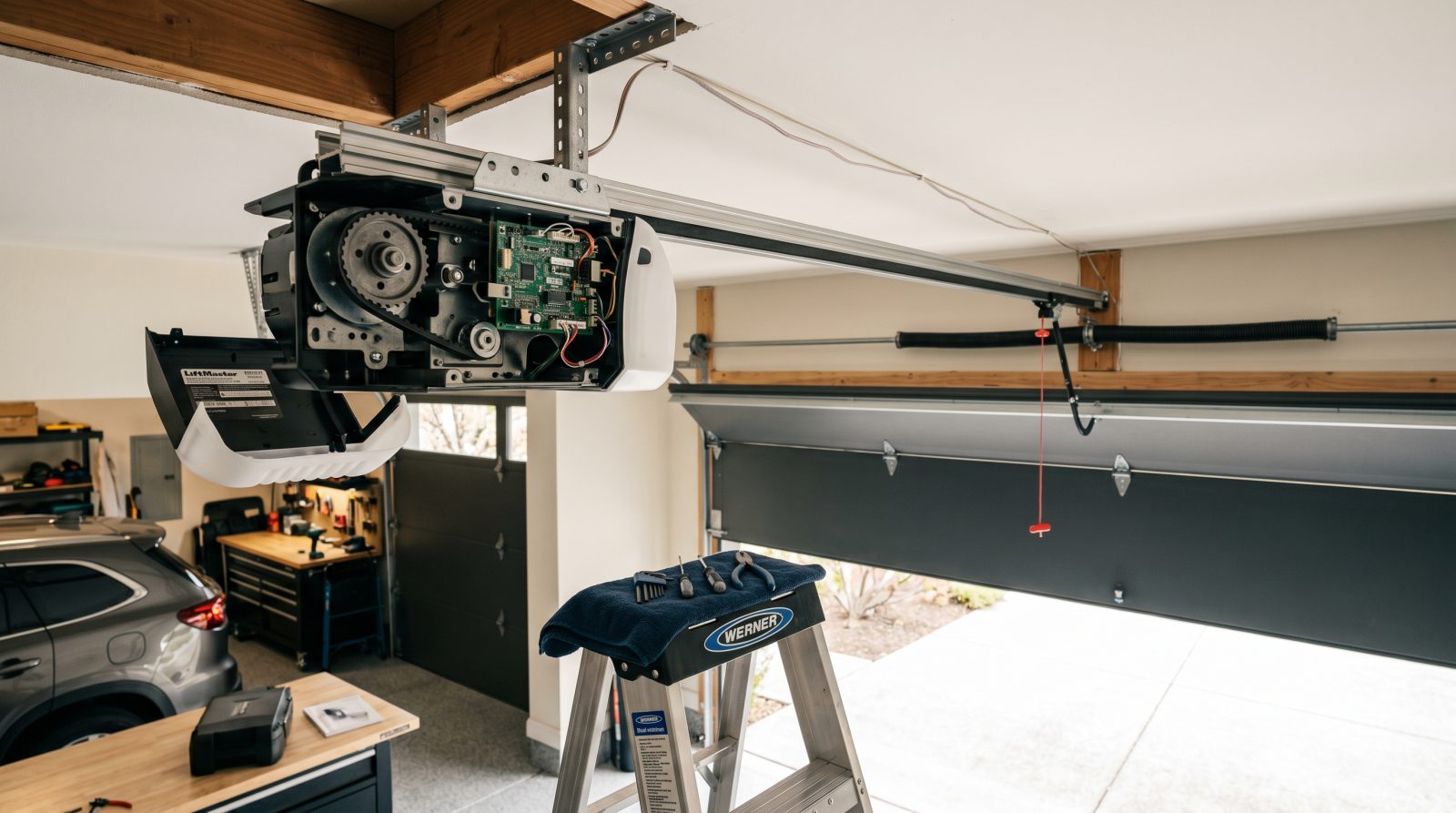
The opener motor turns a trolley along a rail using one of three drive systems: a chain drive (loud, durable, common on older Sacramento homes), a belt drive (quieter, popular in newer Elk Grove and Folsom builds and in homes with a bedroom over the garage), or a screw drive. Inside the motor head, a small plastic or nylon gear meshes with the worm shaft. That gear is intentionally the weakest link, designed to wear out before more expensive parts do, so a worn drive gear is one of the most frequent repairs we make. Above all of it sits the logic board, the opener's brain, which reads the wall button, the remotes, the safety sensors and the travel limits, then tells the motor when and how far to run.
Because so many independent parts have to cooperate, an opener can "fail" in dozens of ways that feel identical from the homeowner's side: the door just won't go up. Our job on a service call is to isolate which link in that chain actually broke, rather than swapping the whole unit by default.
- Motor head: houses the motor, drive gear and logic board, the most repairable section
- Drive system: chain, belt or screw that moves the trolley along the rail
- Logic board: the circuit board that interprets every input and controls travel
- Safety sensors: the two photo-eyes near the floor that stop the door from closing on people, pets or cars
- Travel limits and force settings: tell the opener how far to move and how hard to push before stopping
Common Opener Problems We Diagnose and Repair
Most opener service calls fall into a handful of well-understood failures, and each has a telltale sign. A motor that hums or clicks but does not move the door usually points to a stripped drive gear or a seized motor; if you hear the motor running while the door sits still, the gear is the prime suspect. A door that opens fine but reverses or refuses to close almost always traces back to the safety sensors, which are easily bumped out of alignment in a busy garage. Intermittent dead spots, random behavior, or an opener that ignores both remotes and the wall button often indicate a failing logic board, which can be aggravated by Sacramento's summer heat soaking into an attached garage day after day.
Remote and keypad issues are their own category. A dead remote battery, a deprogrammed unit after a power outage, or interference can all leave you stranded in the driveway. We can reprogram remotes, replace worn wall consoles, and re-establish the link between the keypad and the logic board. We also handle the mechanical wear that creeps in over years of daily use: worn rollers and a dry, gritty rail that make the opener work harder than it should, loose chains that slap and skip, and frayed wiring to the sensors or wall button.
We always check the door's physical balance as part of the diagnosis. If a technician disconnects the opener and the door is heavy, slams down, or will not stay halfway open on its own, the springs or rollers are the real issue and no amount of opener repair will fix it honestly. Telling you that straight, instead of selling you a new opener you don't need, is the whole point of a proper diagnosis.
- Motor hums but door won't move: stripped drive gear or seized motor
- Door reverses or won't close fully: misaligned or dirty safety sensors, or a wiring fault
- Erratic, intermittent, or fully unresponsive operation: failing logic board or capacitor
- Remotes or keypad not working: dead batteries, lost programming, or a worn wall console
- Grinding, slapping, or straining sounds: loose chain, dry rail, worn rollers, or a spring problem masquerading as an opener fault
Safe Troubleshooting You Can Do Before You Call
Some opener problems have simple, safe fixes you can try yourself, and we would rather you save the service call when it's something you can solve in two minutes. Start with the basics: confirm the opener has power. Sacramento's grid sees its share of summer strain and outages, and a tripped GFCI outlet or a breaker is a surprisingly common culprit. Many openers also have a vacation lock or lockout button on the wall console that, when accidentally pressed, disables the remotes; check that it isn't engaged.
Next, look at the two small safety sensors mounted near the floor on each side of the door. Each has a tiny LED. If the door opens but won't close, or reverses immediately, gently wipe the lenses clean and make sure both are pointed at each other so both LEDs glow steady. A bumped bicycle, a stored bin, or a spider web is often all it takes to knock them out of line. If your remote is the only thing not working while the wall button does, try a fresh battery in the remote first.
There is one line we ask you not to cross: never adjust the springs, cables, or the bolted hardware at the corners of the door. Garage door springs hold tremendous stored energy and have caused serious injuries to homeowners who tried to adjust them. If your troubleshooting points to a heavy or unbalanced door, stop there and let a technician handle it with the right tools. When the simple checks don't solve it, that's exactly when our mobile service earns its keep.
- Check power: reset a tripped GFCI outlet or breaker before assuming the motor is dead
- Make sure the wall console's lock/vacation button isn't engaged
- Clean and realign the floor-level safety sensors until both LEDs glow steady
- Swap in a fresh remote battery and try the wall button to isolate the problem
- Do NOT touch springs, cables, or corner hardware; that work is genuinely dangerous
How Our Mobile Opener Repair Works in the Sacramento Area
Because we're a mobile company, the repair happens in your driveway, not at a shop you have to haul a heavy motor unit to. When you request a quote, we get the make and model of your opener and a description of the symptom so the technician can load the likely parts before heading out, common drive gears, capacitors, rollers, sensors and remotes ride on the truck. That means many opener repairs are completed in a single same-day visit instead of a return trip.
On site, the technician runs a full diagnosis rather than guessing: testing the motor and capacitor, inspecting the drive gear, checking the logic board's response to each input, verifying sensor alignment and wiring, and manually balancing the door to rule out spring trouble. You get a clear explanation of what failed and an honest recommendation, repair the existing unit when it's the sound choice, or replace it only when the motor is truly burned out or the unit is too old to source parts for. Cost depends on the specific part and labor involved; as a general guide, replacing a drive gear or sensors sits at the lower end of the typical industry range, a logic board or capacitor in the middle, and a full opener replacement at the higher end. We give you the number before any work begins.
We serve homeowners across the greater Sacramento region, from the older chain-drive openers in Curtis Park and East Sacramento bungalows to the newer belt-drive units in Natomas, Elk Grove, Folsom, Roseville and Rancho Cordova. Detached garages, alley-access garages downtown, and tandem garages in newer subdivisions all get the same thorough treatment, and you never have to step inside a storefront to get it.
- We come to you: full diagnosis and repair done in your driveway, no drop-off
- Truck-stocked parts make most opener fixes a same-day, single-visit job
- Honest repair-vs-replace guidance, with the door's balance always checked
- Transparent pricing in plain industry ranges, confirmed before work starts
- Service across Sacramento, Elk Grove, Folsom, Natomas, Roseville, Rancho Cordova and nearby communities
Repair or Replace? Making the Right Call on Your Opener
Not every failed opener needs to be replaced, and not every old opener is worth saving. The deciding factors are the cost of the specific repair, the age of the unit, and whether replacement parts are still available. A ten-year-old chain-drive opener with a stripped gear is almost always worth a quick, inexpensive gear repair. A twenty-year-old unit whose logic board has died, and whose board is no longer manufactured, is usually a better candidate for replacement, where the new unit cost comes with modern safety sensors, rolling-code security, and far quieter operation.
Safety and security also weigh into the decision. Openers made before the early 1990s may lack the photo-eye reversing sensors now considered standard, and older fixed-code remotes are easier to intercept than today's rolling-code systems. If your opener is from that era, replacement isn't just about convenience, it meaningfully improves how safe the door is around kids and pets and how secure your garage is. For homes with living space above the garage, a common layout in newer Sacramento developments, upgrading a noisy chain drive to a belt drive can be worth it for the quiet alone.
Whatever the verdict, we lay out the trade-offs and let you decide. There's no upsell pressure, because a fairly repaired opener that lasts you another five years is exactly the kind of work that earns a repeat customer and a referral down the street.
- Repair makes sense when the part is inexpensive and the unit is otherwise sound
- Replace when the motor is burned out, parts are discontinued, or the unit is very old
- Pre-1990s openers without reversing sensors are worth replacing for safety alone
- Belt-drive upgrades are popular for garages with bedrooms or offices overhead
- You get the trade-offs in plain language and make the final call